
To attract and retain top talent, your business needs a great benefits package with perks to match. While health insurance and a competitive salary are a great start, many companies are beginning to offer employee stipends as part of their total compensation to attract skilled workers.
Once you know what stipend to offer, the next decision is tooling - our breakdown of the top employee stipend platforms compares the leading options.
With the ability to enhance health & wellness, reimburse education or training expenses, improve lifestyles, bolster home offices, and provide financial support to offset living expenses, stipends are a fringe benefit that every business owner and manager should consider.
With our ultimate guide to employee stipends, you can learn the key aspects of offering them and how they can boost employee morale, retention, and engagement; reinforce a strong company culture; and increase your bottom line.
Hoppier’s Ultimate Guide to Employee Stipends

Before we dive into this comprehensive guide to employee stipends, it’s important to understand some of the core ideas. By learning how it works, you can decide what stipends you want to offer upfront on top of your employee benefits program.
What Is a Stipend?
A stipend is a form of compensation offered to trainees and employees for job training, continuing education, career development, or completed work. This compensation is often given to full-time employees in addition to a regular salary, but a company can also offer a stipend to non-salaried or part-time employees.
Generally speaking, the stipend amount is fixed - a flat figure that’s the same amount, regardless of the frequency of the stipend given. Businesses provide a stipend for many reasons, including cost-of-living increases, health and wellness perks, home office upgrades, and more.
Outside of the business world, stipend usage is somewhat common, particularly in academia. Graduate students and fellows commonly receive a research stipend to complete approved academic research or finish their dissertations. College students may also receive a stipend for books, a laptop, or other school supplies via an academic scholarship.
Other common recipients of stipend payments may include clergymen, apprentices, or non-employee trainees.
How Do Stipends Work?
Stipends are a fixed amount of money that’s given to an employee or trainee for specific purposes that benefit the person receiving the cash. While some are a one-off payment, others are given as a daily, weekly, bi-weekly, or monthly stipend - most often in a lump sum payment of the same amount. In some instances, organizations may give stipends at the end of the year, depending on the line of work or how they’ve structured their stipend program.
Once the employee or trainee receives the stipend, they can use the cash to offset expenses. Regular employees may use the money to pay for additional education or certifications, professional development, gym memberships, travel expenses (per diem), or anything else outlined by the employer. Trainees usually use a stipend to pay for living expenses as they gather the experience and expertise necessary to become full-time employees.
Any money remaining goes into the pocket of the recipient. It’s a form of compensation, so the employer cannot ask for the money if the employee or trainee doesn’t use all of it. However, the Department of Labor doesn’t limit stipends; companies can make them as small or as large as they want.
Stipend programs aren’t regulated to a specific industry or organization either. Government agencies, nonprofit organizations, and for-profit companies can all provide stipends to their employees.
How Much Should Your Stipend Be?

As with compensation, the amount a company provides as a stipend correlates with its budget, talent acquisition expectations, and employee satisfaction initiatives. Higher stipends may attract better talent and make positions in high-cost-of-living areas more attractive. Lower stipends, especially in the nascent stages of a program, may also be appreciated by current employees who’ve never had one.
Stipends are loosely controlled by the Fair Labor Standards Act, but individuals must meet eligibility requirements to receive a larger stipend than you offer. Though businesses don’t have to pay a minimum stipend, they may have to dole out a large enough stipend so the employee's compensation reaches minimum wage plus any overtime pay (1.5x minimum wage). Note that this situation is only for those classified as employees - never interns or trainees.
If you have interns and trainees, your stipend does not have to meet minimum wage requirements. Because interns and trainees aren’t classified as employees, a stipend is the only compensation you must provide.
Unpaid internships are still legal under the Fair Labor Standards Act, so long as the intern takes the position with no expected compensation.
How Much Should Your Stipend Be?
Interestingly, this ultimate guide to employee stipends can’t guide you to the perfect dollar figure. It’s entirely subjective and unique to your business.
Instead of selecting an arbitrary amount, consider your employees and their unique needs when you set the stipend amount. For example, if your team works remotely, consider a monthly stipend that allows them to rent a coworking space or meet with others for lunch.
Another methodology for your stipend amount is to contemplate the benefits of investing in your employees. For instance, if an employee with an annual salary of $60,000 is more comfortable and 10% more productive ($60,000 x 10% = $6,000) with a $500 office chair, then the investment is justifiable. You can then use this as a basis to help you set stipend amounts for furniture, but also for other areas like wellness or productivity.
To help you find the right figure, take a look at the stipends that other leading companies offer their employees. Here you can find examples of high-budget learning stipends, affordable lunch allowances, and more creative stipends.
Why You Should Consider a Stipend for Your Business
A boost to employee morale can promote productivity and a happier workforce. Based on that fact alone, you should highly consider a stipend for your business.
However, a stipend can also lure talent from other organizations, giving you a vastly improved workforce while rapidly expanding your candidate pool. If attracting talent or retaining it is a concern, stipends do the heavy lifting. It’s an opportunity for you to promote wellness, increase employee engagement, and build a better work culture.
Different Types of Stipends Offered by Employers

Stipends come in many different forms. So whether you want to offer a perk or a work-related benefit, a stipend covers you.
The beauty of stipends is that you can tailor them to fit your company and your employees. Take the dating app Hinge, for example. The company offered employees in its New York office a $200 monthly stipend to spend on dates. The app’s founder, Justin McLeod, said his favorite story of an employee using the benefit was a cat-themed date that one employee planned for their significant other.
As part of our ultimate guide to employee stipends, we’ve put together a list of some of the most common for your consideration.
- Health and wellness stipends provide employees with mental health issues, relaxation, and physical wellness, such as gym or yoga lessons.
- Meal stipends are a fixed sum of money your employees can use for lunch at the office, at home, or on the road
- Moving stipends are often necessary to attract top talent. If your preferred candidate lives in a different city, a moving stipend can attract them to the position.
- Commuting stipends cover the expense of driving to work or taking public transportation.
- Remote work stipends allow hybrid or work-from-home employees to improve their home office through hardware upgrades, decor, or furniture.
- Health insurance stipends offset the cost of any healthcare needs an employee may have during the year.
- Employee recognition awards and stipends offer a token of gratitude for an overachieving or long-tenured employee.
- Professional development stipends/educational stipends allow your employees to expand their knowledge through in-person or online courses and certifications. This could also include student loan stipends for employees currently saddled with educational expenses.
- Cell phone stipends provide payment for a work phone.
- Lifestyle spending accounts, or LSAs, are flexible, broad accounts that improve the employee experience and well-being. If you’re offering stipends but aren’t sure which perks are best for your team, LSAs cover just about everything - from employee wellness to home office setups to childcare.
Further Reading on Stipends
If you’re interested in implementing a specific stipend at your business or meet competitive benchmarks and metrics in the stipend space, our in-depth guides provide excellent guidance. We’d be remiss in this ultimate guide to employee stipends without giving you additional information, so check these out for more tips:
- Food and meal stipends
- Phone stipends
- General stipends
- Relocation stipends
- Vehicle and gas stipends
- Per diem/travel stipends
How Frequently Are Stipends Given?
Companies can give stipends at whatever frequency they choose. Typically, stipends are given on a monthly basis, as most living expenses or lifestyle expenses (health and wellness, gym, yoga, etc.) are charged monthly as well.
In some cases, the frequency may change. Traveling employees may get a daily or weekly stipend, depending on how long they’re out of town. Or, to avoid the hassle of budgeting for monthly stipends, some companies may choose to provide an end-of-year stipend.
Much to the benefit of organizations, the frequency and amount of stipends are completely customizable. Simply find a dollar amount and payment frequency that works with your budget and staff.
Are Stipends Taxable? Your Questions Answered
.png)
"Are stipends taxable?" is one of the more common questions for both employees and employers. Understanding the tax-related aspects of these impacts both employees and employers, so education is an integral part of this ultimate guide to employee stipends.
The tax implications for stipends vary. Some stipends are taxable; some are non-taxable. The only foolproof way to know if the Internal Revenue Service (IRS) wants its cut is by referring to IRS Publication 15-B: Employer’s Tax Guide to Fringe Benefits. This specifically outlines what stipends are taxable.
In general, stipends that act as perks fall under taxable income. As a result, employees must pay income tax on them just as they would with regular pay, along with both Social Security and Medicare taxes (FICA).
Employers can choose whether to withhold income taxes or give the stipend to employees without tax withholding. In most cases, employers should take taxes out on the front end to limit employee difficulties come tax time.
Regardless of whether you choose to withhold taxes, the employee must disclose this compensation on their tax return. Some examples of tax-free stipends include:
- Retirement planning services
- Vision insurance
- Term life insurance coverage
- Phone allowances
- Disability insurance
- Dependent care assistance
- Commuter benefits (up to $300 per month)
- Gym membership (only if operated by the employer)
- Adoption assistance
- Achievement or recognition awards (up to $1,600 per year)
If your stipend in question isn’t on this list, it’s probably taxable. But again, refer to IRS Publication 15-B to make sure.
Stipend vs. Salary vs. Per Diem vs. Allowance vs. Reimbursement: What’s the Difference?
While this ultimate guide to employee stipends focuses almost exclusively on the idea of stipends, other words are thrown around that can get confusing. Here are some phrases often used synonymously with a stipend and what they actually mean.
- Stipend: As mentioned above, a stipend is compensation paid to a trainee, employee, or intern for work completed, services provided, or as a perk.
- Salary: A salary is an agreed-upon amount - either an annual or hourly wage - that’s given to an employee in return for services or work.
- Per Diem: A per diem is a type of stipend provided to employees who travel for work. A traveling employee uses a per diem to pay for transportation, meals, dry cleaning, and other work-related trip expenses.
- Allowance: Allowances and stipends are usually the same thing; they’re just different verbiage. However, allowances may refer to more specific purposes as opposed to stipends, which may have a broader insinuation.
- Reimbursement: Though similar to a stipend, reimbursements are a bit different. Instead of an employer paying the same amount to an employee each month, they pay the employee for an expense to the exact amount spent by the employee. At Hoppier, we specialize in both stipend management and employee expense reimbursements, so we have you covered either way.
Introduce Stipends the Easy Way
Stipends don’t have to be complicated, but many company stipend programs are. If you have to individually track, approve, and provide reimbursements for each team member who uses their stipend, you'll need a full-time team member just to manage the program.
Avoid the complicated logistics by managing your stipend program with Hoppier virtual credit cards. With Hoppier cards, you can set up a stipend program and issue credit cards to each of your team members with only their email addresses.
You can set a budget and choose acceptable vendors. If your stipend is for a wellness program, limit vendors to gyms and health subscriptions. If you want to offer remote employees a home office budget, limit it to furniture and office supply stores.
You have the power to set your digital credit cards up to cover whatever spending makes sense for your company. Plus, you can brand the card with your company colors and logo - a fun way to reinforce your culture.
Use Hoppier For an Easy Stipend Solution
Hopefully, our ultimate guide to employee stipends has pointed you in the right direction. With a bit of foresight and a discussion with your HR leaders and team, you can start to make some decisions regarding your own stipend program.
If you want to initiate health and wellness programs, home office upgrades, or include allowances for educational expenses, stipends are a smart move. You can attract talent, retain tenured employees, and boost morale all in one program.
Once you've done the planning and you're ready to select a provide, let Hoppier's employee stipend program do the heavy lifting.
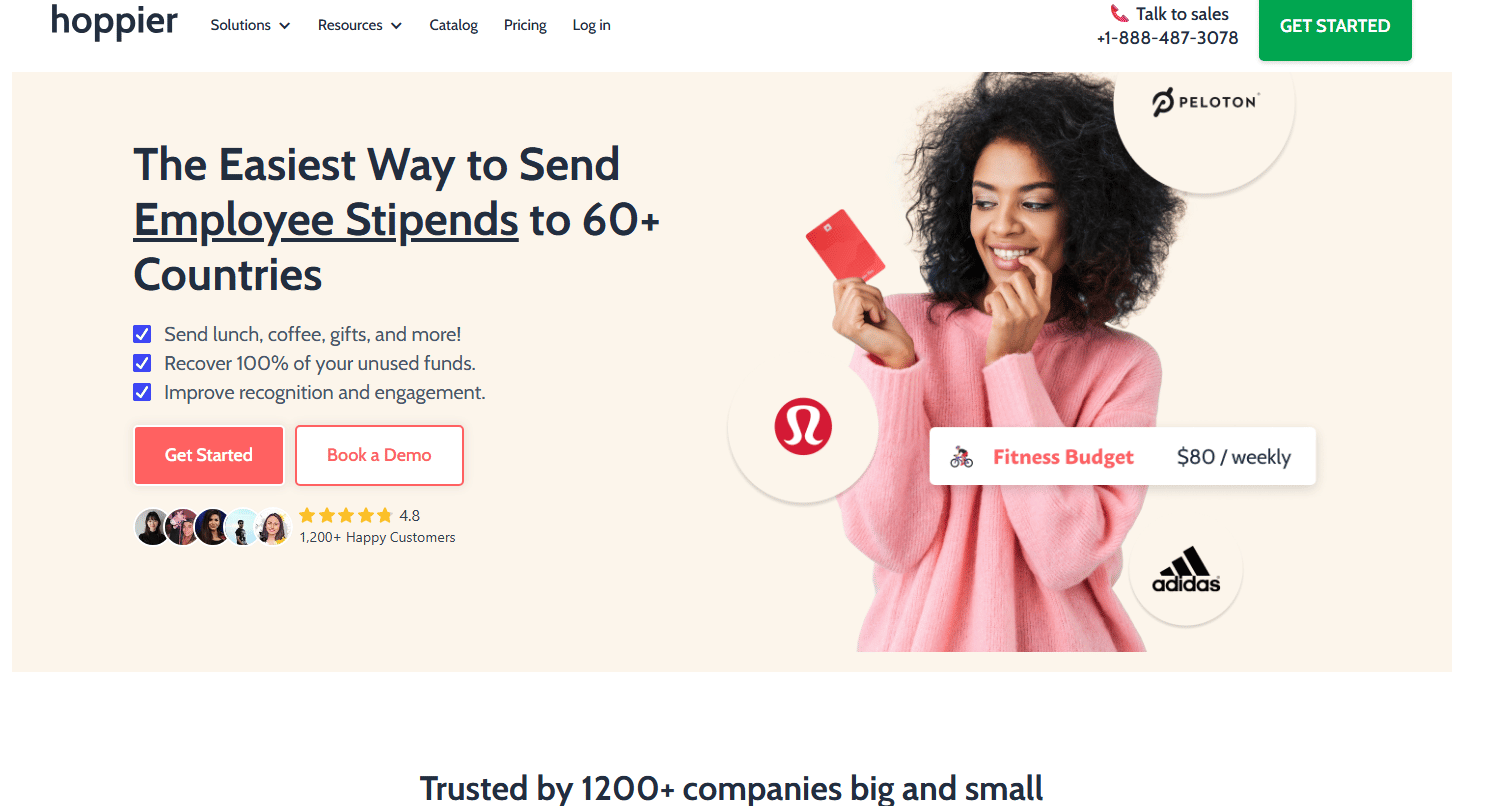
Hoppier is here to streamline your stipend program. With bulk virtual gift cards from Hoppier, you allow employees to purchase what they need based on your stipulations. Whether you want to offer meals when working remotely, gym memberships to potentially lower insurance costs, or show employee appreciation, Hoppier’s gift cards are a simple, one-size-fits-all solution.
.png)


Make Hoppier your unfair advantage
Send rewards, gifts, and perks to employees, clients, and event attendees in 60+ countries - all from one platform.
Get Started