How to Automate Gift Card Distribution: APIs, Webhooks, and Integrations
Four ways to automate gift card distribution - CSV batching, native integrations, webhooks plus a gift card API, and AI assistants via MCP - compared honestly, with real platform data: 4,389 of 4,390 programs created last year were one-time sends.



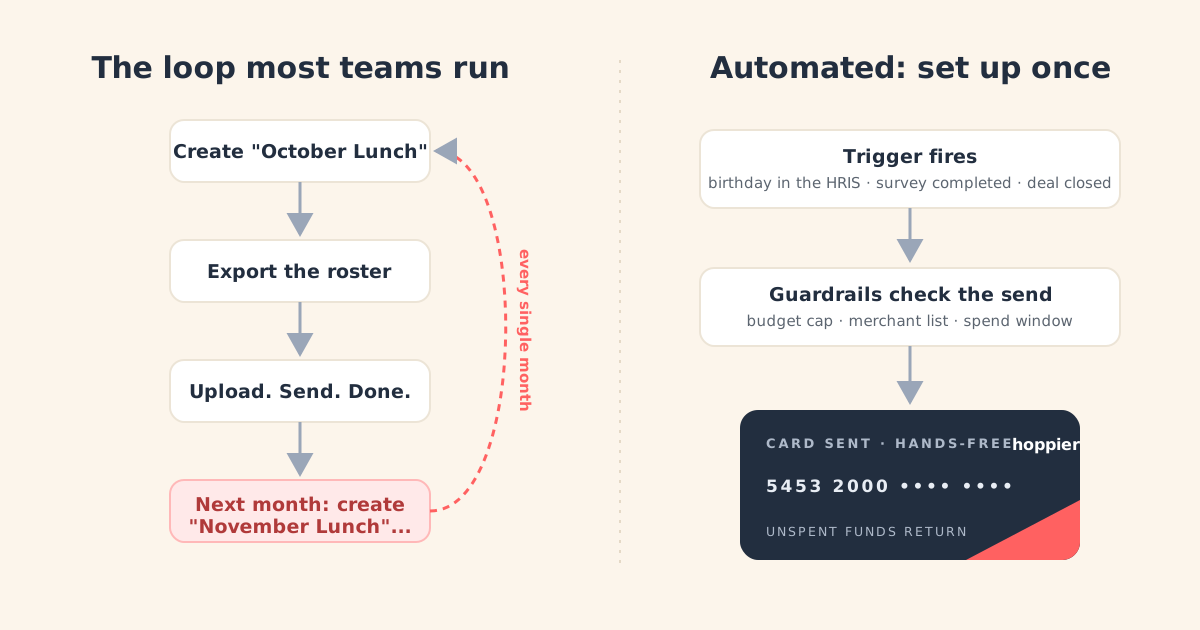
We pulled every program created on Hoppier over the past twelve months before writing this guide: 4,390 programs across 488 companies. 4,389 of them were set up as one-time sends. Exactly one used a recurring schedule.
That is not because gift card sending is naturally a one-off job. 436 of those program names contain a month name ("October Lunch", "November Lunch", "December Lunch"). One software company recreated the same birthday program 42 times in a year. A senior-living operator rebuilt their birthday send ten separate times at roughly $3,770 a round. The busiest company on the platform created 2,282 one-time programs in twelve months - more than six a day, every day, by hand.
Nobody does that because they enjoy the create-program screen. They do it because the trigger never got wired up. This guide covers the four ways to fix that, what each one is actually good for, and which one to pick based on what starts the send.
Quick answer: match the delivery method to the trigger. Date on a calendar (birthdays, anniversaries): one standing program fed by your HRIS roster. Event in another tool (survey completed, deal closed): a native integration where one exists, or a webhook into the gift card API (closed beta). Fixed schedule (monthly lunch, quarterly recognition): one program you top up, or an AI assistant on the Hoppier MCP that runs it for you. True one-off: a CSV bulk send - do not automate what happens once.
What counts as automation (and what does not)
Uploading a CSV of 300 people is batching, not automation. It is the right call for genuinely one-time sends - a holiday gift, a conference, a launch celebration - and the bulk send walkthrough covers it in five steps. The problem starts when the "one-time" send happens every month. Then the CSV is a recurring chore with a different name, and someone exports a roster, checks it against last month, and rebuilds the program. Every time.
Automation means the send fires from the event itself. A birthday arrives, a survey response lands, a deal closes, and the card goes out with nobody preparing a list. Everything below is about getting there.
The Four Delivery Approaches, Honestly Compared
1. CSV bulk upload: the manual baseline
Three columns - name, email, amount - uploaded to the dashboard. Minutes of work at any volume, no technical setup, and the full order is reviewed before anything sends. Use it for one-offs. Outgrow it the third time you rebuild the same list.
2. Native integrations: best where they exist
A native connection means the trigger and the send live in the same place. Our Salesforce integration (beta) sends cards to leads, contacts, and opportunities from inside the CRM. HRIS and survey tools connect today via roster export, Zapier, Make, or n8n - the integrations directory shows what each tool supports and how. Honest status: the list of native connections is growing but short, which is why the next two options exist.
3. Webhooks plus the gift card API
This is the engineer's path and the most flexible one: any system that can fire a webhook can trigger a send. Survey completion in Typeform, a stage change in your CRM, a milestone in your own product - the event posts to your endpoint, your code calls the API, the card goes out. The Hoppier gift card API is in closed beta right now, with public documentation on the way; if you have a workflow waiting, it is worth the email.
4. An AI assistant through the Hoppier MCP: live today
The newest path, and the one that surprised us by becoming the practical default while the API finishes its beta. Connect Claude or ChatGPT to the Hoppier MCP and the assistant can run the whole workflow in plain language: it reads your roster or spreadsheet, creates the program (create_program), loads people (add_participants), and sends funds (send_topup). You say "pay this week's survey completers $25 each" and review what it drafted. Guardrails - budget caps, merchant restrictions, spend windows - are enforced on our servers, not in the prompt, so the assistant cannot exceed what you allowed.
Match the Method to the Trigger
| What starts the send | Example | Right approach |
|---|---|---|
| 📅 | A date: birthdays, work anniversaries | One standing program + your HRIS roster - see the birthday automation guide |
| ⚡ | An event in another tool: survey completed, deal closed, referral made | Native integration where it exists; otherwise webhook into the API (closed beta) |
| 🔁 | A schedule: monthly lunch, quarterly recognition | One program, topped up on the date - by you, or by an assistant on the MCP |
| 🎁 | A one-off: holiday gifts, an event, a thank-you | CSV bulk send. Do not build automation for this |
Three Worked Examples
Birthdays without a spreadsheet
The company that rebuilt its birthday program 42 times was doing real work every time: check who has a birthday, create a program, type the names, send. The automated version is one program with the budget and claim window set once, and the only recurring input is the roster - synced from the HRIS, pulled by an assistant, or updated as people join and leave. The dates already live in your people system; the whole job is connecting them to the send. Full setup, including anniversary tiers by tenure, is in the birthday and anniversary guide.
Survey completions that pay themselves
Research teams feel the recreation loop hardest because every wave is "one more send." The workflow that removes it: completion in Typeform or Qualtrics fires a webhook, the webhook triggers the send, the respondent picks a card in their own currency the same day. Same-day payment measurably improves panel show rates, and unclaimed incentives return to the research budget instead of vanishing. Amounts, ethics-board considerations, and international payouts are covered in the survey incentives guide.
The monthly team lunch
The clearest signal in our data: 1,244 of the year's programs - from 73 different companies - were lunch or meal sends, and the month-name titles show most were rebuilt monthly. The fix is structural: one lunch program, not twelve. The people stay loaded, the merchant list stays set, and the monthly action shrinks to a top-up that an assistant can run on schedule. The lunch program guide has the full build, including multi-country vendor lists and spending windows.
What To Automate First
Search your own program list for a month name. If anything comes back, that program is your first candidate - it has already proven it recurs. The rule we give customers: the third time you create the same program, stop and wire the trigger instead. Setting up the automated version takes about as long as one manual round, and every round after that is free. A wider look at program economics, taxes, and the launch checklist lives in the corporate gift card program guide.
The Guardrails That Make Automation Safe
The reasonable fear about automated money: what if it sends wrong? This is why controls belong on the platform, not in your trigger code or your prompt. On Hoppier every automated send runs inside limits set when the program was created: a per-person budget, an allowed merchant list, a spend window, an expiry date. An assistant or an API call cannot exceed them. And the failure mode is forgiving - across 2,090 programs on our platform, 37% of sent value goes unspent, and on Plus plans all of it returns to your balance. An automated send that someone never claims costs you nothing.
FAQ
Can I automate gift card sending without engineers?
Yes. A standing program plus a current roster handles date-based sends; Zapier, Make, or n8n handle event-based ones without code; and an AI assistant on the Hoppier MCP runs scheduled sends in plain language. The API is the engineer's option, not the entry requirement.
Is the Hoppier API publicly available?
It is in closed beta, and public documentation with self-serve signup is in the works. The API page is where to raise your hand - teams with a live workflow get onboarded first.
What happens to cards nobody claims?
On Plus plans, 100% of unclaimed and unspent value returns to your balance after the expiry window you set. That makes automation low-risk: you pay for what gets used, not what gets sent.
How do recipients get their reward?
One email with one link. They pick from 3,000+ gift card brands or a prepaid Visa, in their own currency, across 60+ countries. No app, no account, no bank details.
Make Hoppier your unfair advantage
Send rewards, gifts, and perks to employees, clients, and event attendees in 60+ countries - all from one platform.
Get Started