Gift Cards vs. Prepaid Visa Cards for Employee Rewards: Costs, Controls, and Unused Funds
Gift cards vs prepaid Visa cards for employee rewards, compared honestly: claiming vs spending, brand lists vs merchant-category restrictions, KYC requirements, fees vs recovery, and three worked examples - including when plain gift cards are enough.



Quick answer: gift cards are faster to start and familiar to everyone - but once claimed, the balance is committed, spent or not. Prepaid Visa cards cost more to run (and require a KYC form) but reach anywhere Visa is accepted, restrict spending by category instead of by brand, and return every partially-unspent dollar to you. Rule of thumb: one-off rewards and fast launches take gift cards; recurring meal, stipend, and international programs earn the Visa.
This is the most common fork in the road for anyone setting up employee rewards, and the two products behave differently in exactly the ways that don't show up on a pricing page: who can spend where, what happens to money nobody uses, and what you have to file to send each one. Here's the honest comparison, worked examples included.
The Two Products in One Minute
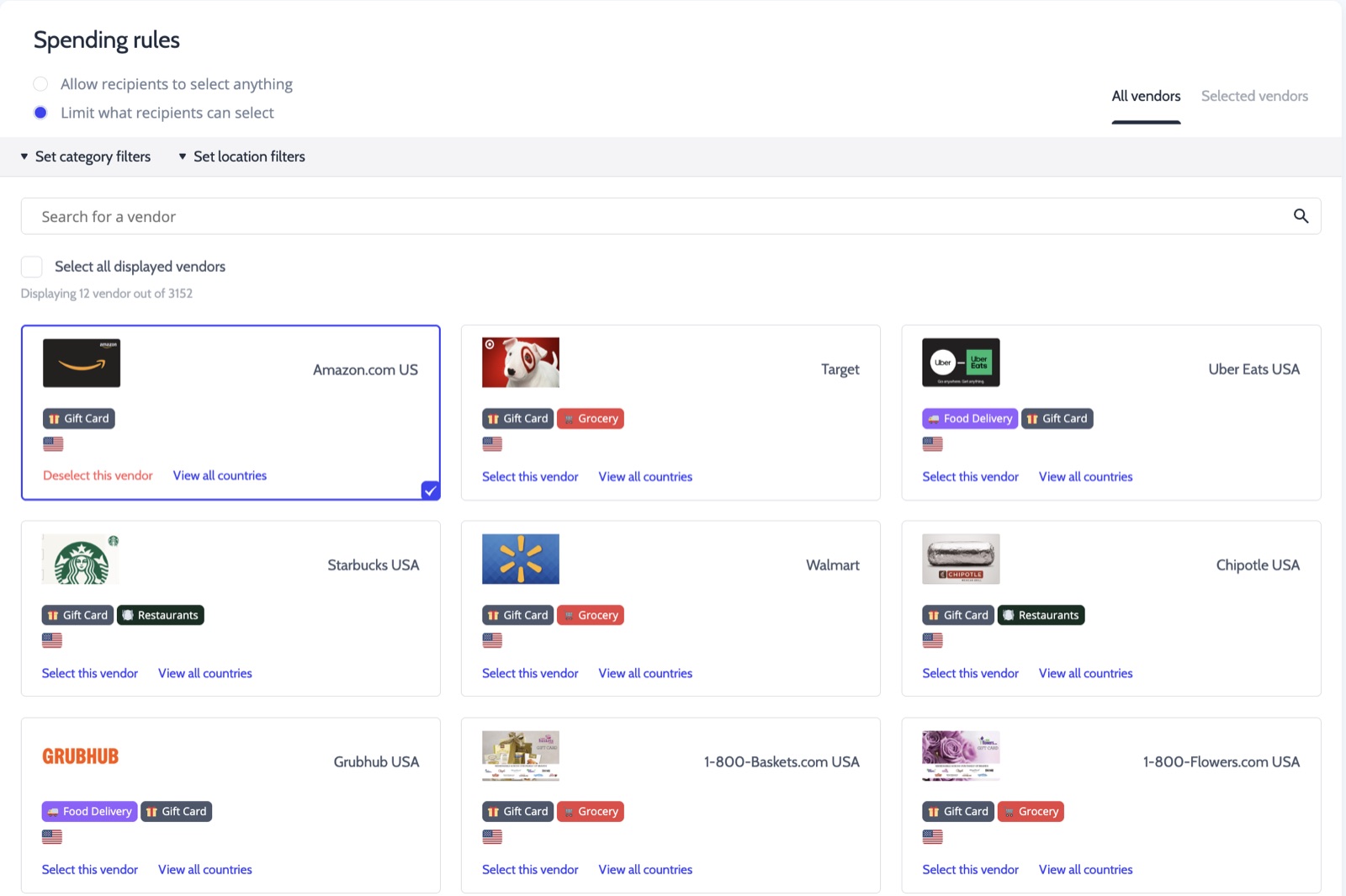
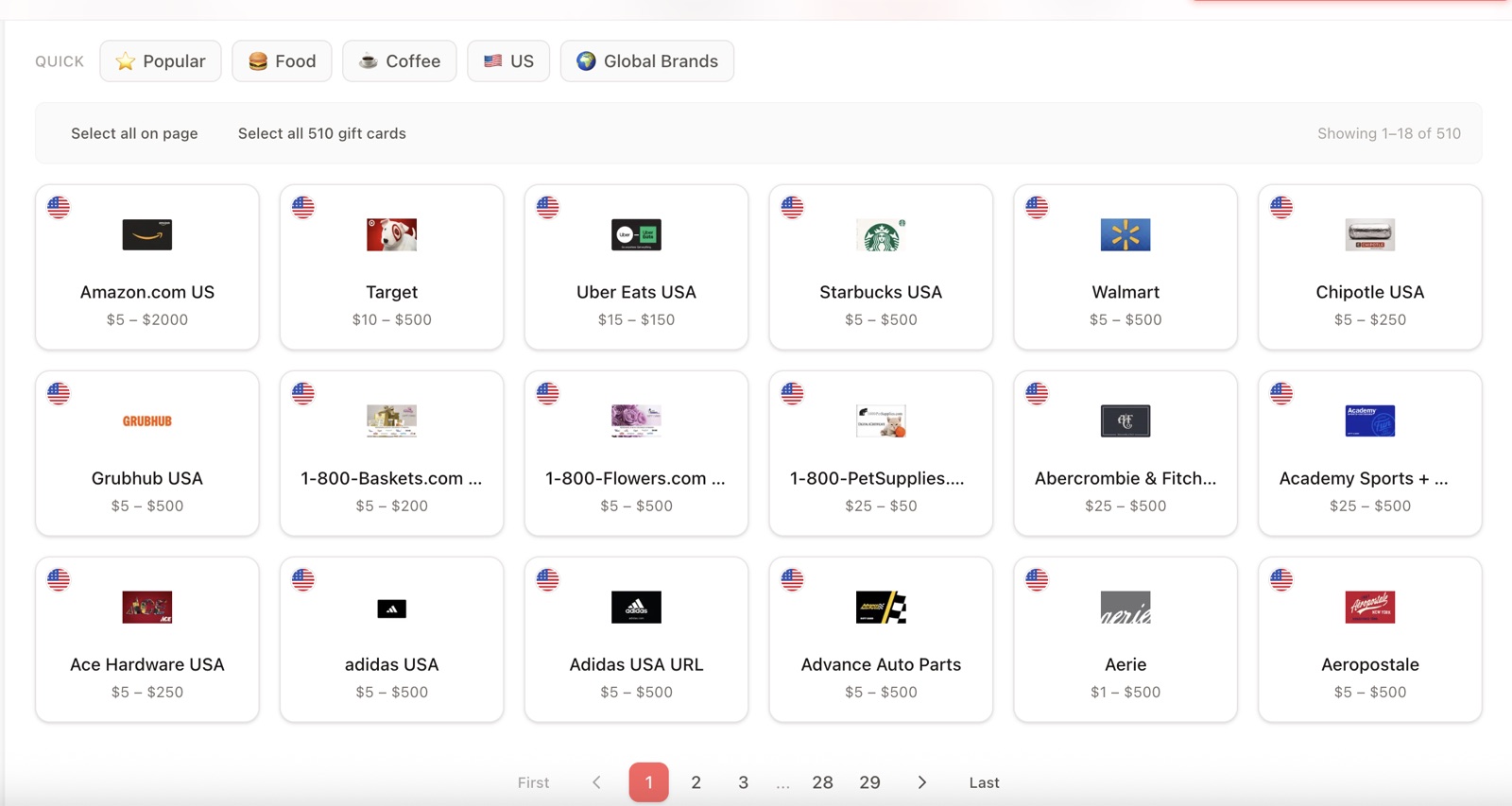
The gift card catalog: 3,000+ brands - Amazon, Target, Starbucks, Uber Eats, and every big-box retailer you'd buy a card from - with options covering North America, Europe, Asia, and Latin America. Recipients recognize them instantly.
The prepaid Visa: a virtual card that works anywhere Visa is accepted - which is what rescues the long tail. Your local pizza place and the cafe on the corner don't run gift card programs; a Visa reaches them anyway. Recipients claim it in the app, add it to Apple Pay or Google Pay, and tap in person - or read it over the phone to order.
Restrictions: Brand List vs. Category
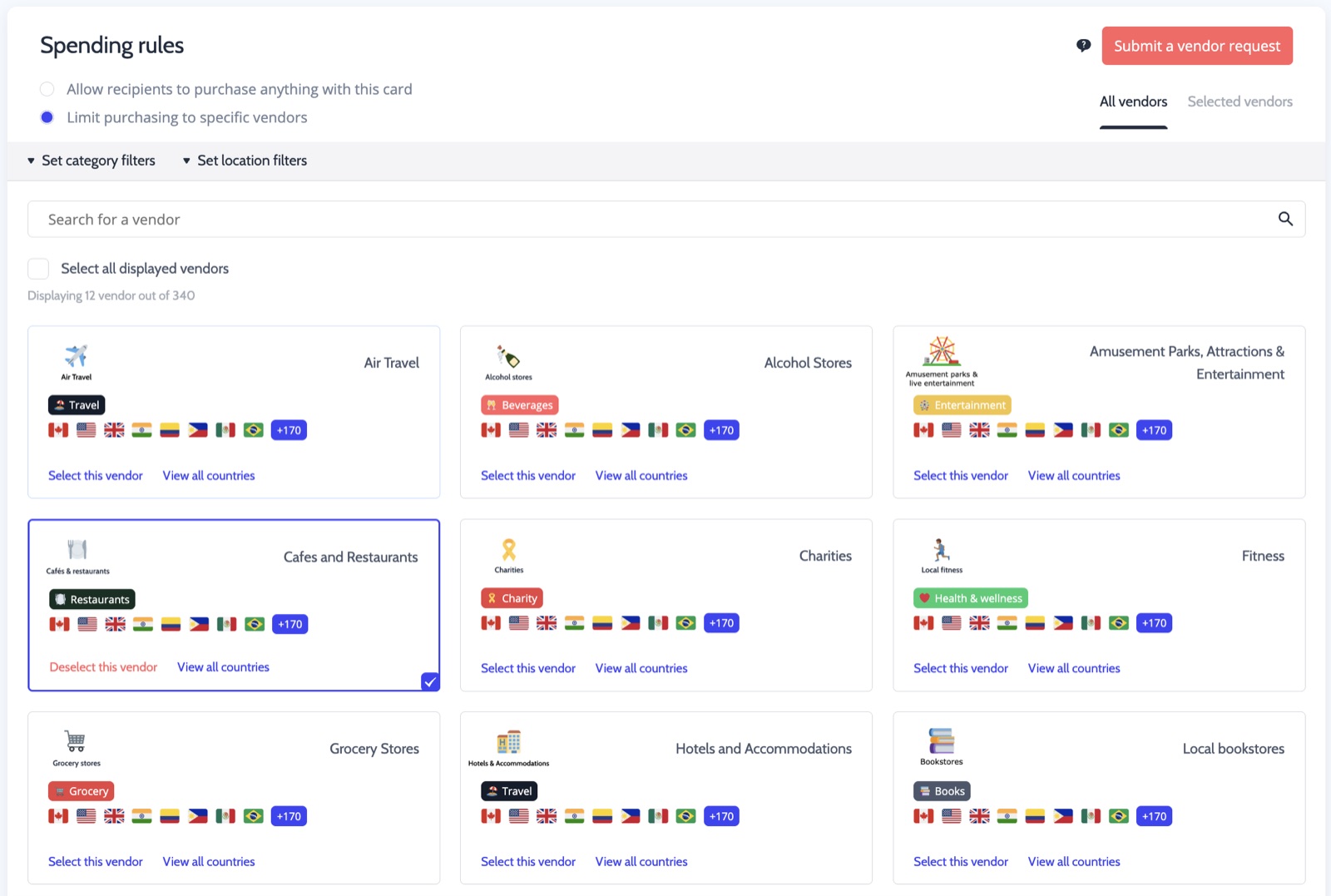
Both products let you theme a program, but at different resolutions. Gift cards restrict by brand list: you pick which of the 3,000 vendors are claimable. The Visa restricts by merchant category, which is both broader and more precise:
Thanks to Visa merchant codes we can restrict a card to, say, any cafe and restaurant - every restaurant in the world that accepts Visa, including the ones that will never have a gift card program. Same themed program, more granular control, more coverage.
Emil Aite, Co-Founder & CTO
The Money: What Comes Back and When
This is the fork that decides most purchases. In both products, unclaimed value never leaves your balance - if someone ignores the email, you lose nothing. The difference is what happens after a claim:
- Gift card claimed: the balance moves onto the card and it's committed - spent or not. Consumer statistics put gift card breakage around 30%; people claim cards and forget them.
- Visa claimed: the card spends against your ongoing balance. Partial spends leave the remainder with you - a $50 card used for a $41 lunch returns $9, automatically.
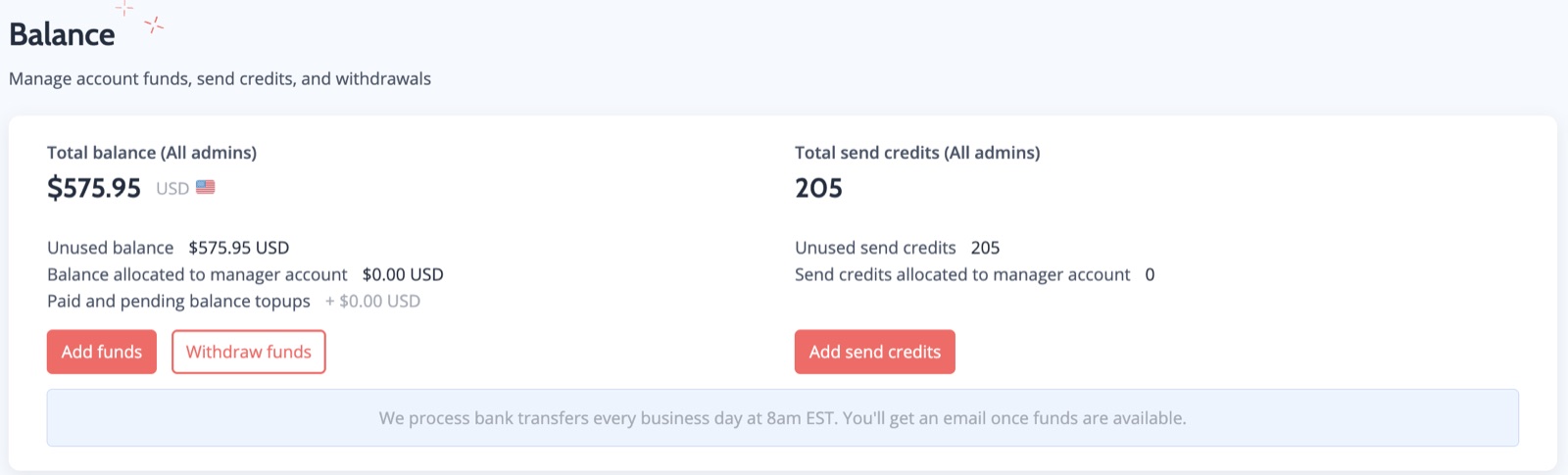
At program scale that difference is a line item. Across 2,090 programs on our platform, 37% of sent value goes unspent on average - on a recovery model that's budget back; on committed gift cards it's gone. The full mechanics are in the breakage breakdown.
The Paperwork: Why Visa Requires KYC
Prepaid Visa cards are considered sending money online, so businesses submit a KYC - know your customer - form when they sign up to send them. It's a one-time compliance step, a little stricter than gift cards, and it's why the Visa side isn't instant to start.
Emil Aite, Co-Founder & CTO
Translation: gift cards start today; Visa starts after a short verification. If your program launches this afternoon, that alone may decide it.
Fees, Honestly
- Free tier: the full gift card catalog, every platform feature, the API and the MCP. What it excludes: prepaid Visa cards (they cost money to issue) and the pre-built HRIS/CRM integrations, which mostly matter to larger recurring programs anyway.
- Paid plans: start at $590/year with 100 send credits included (a send credit covers adding one recipient), unlocking the prepaid Visa, money transfers, and the pre-built integrations.
So the real cost comparison isn't fee vs. fee - it's fee vs. recovery. A paid plan earns itself back when the Visa's partial-spend recovery on a recurring program exceeds the subscription, which happens quickly at lunch-program scale.
Three Worked Examples
1. A $50 birthday gift
Gift card. It's a one-off, choice is the point, and unclaimed cards return to balance anyway. Free tier covers it entirely. (Full setup: automating birthday gifts.)
2. A one-time webinar lunch for 120 people
Either - lean gift card. Delivery-app gift cards (Uber Eats, DoorDash, Grubhub) cover most attendees, no-shows never claim, and launch is same-day. Go Visa only if your audience includes countries the catalog covers thinly.
3. A $25/week team lunch across 9 countries
Prepaid Visa, clearly. Category restriction (restaurants + food delivery + grocery), local spending in local currency, in-person tap at places with no gift card program, and every partially-unspent lunch returns to the budget - weekly. This is the program where recovery outruns the subscription. (Implementation: the lunch program guide.)
When Plain Gift Cards Are Simply Enough
If your program is occasional, domestic, and choice-driven - birthday gifts, a quarterly thank-you, survey incentives - the free gift card tier is genuinely sufficient, and anyone telling you otherwise is selling. The Visa earns its cost when programs are recurring, category-restricted, or international. Most companies end up running both: gift cards for celebration moments, Visa for the operational programs.
FAQ
Can recipients choose between a gift card and a Visa?
You decide per program: gift card catalog, prepaid Visa, or money transfer. Many programs offer the catalog with the Visa as one of the options.
Do unused gift cards come back to me?
Unclaimed ones, yes - always. Claimed-but-unspent ones, no: once claimed, a gift card's balance is committed. That after-claim recovery is the Visa's advantage.
Why does the Visa require extra verification?
Issuing spendable Visa balances is regulated as money movement, so a one-time KYC form is required. Gift cards have no such step.
Still deciding? Walk through your program with us and we'll tell you honestly which product it needs - or start free with the gift card catalog and add the Visa when a program earns it.

Make Hoppier your unfair advantage
Send rewards, gifts, and perks to employees, clients, and event attendees in 60+ countries - all from one platform.
Get Started