Sendoso Alternatives: An Honest Guide for Teams That Mainly Send Gift Cards
An honest Sendoso alternatives guide for teams that mainly send gift cards: both sending flows with screenshots, why unredeemed value is the real cost difference, what you'd give up (physical gifting, for one), and when to keep Sendoso.



Sendoso is a good product. If this guide were a teardown pretending otherwise, you should not trust the rest of it. But "good product" and "right product for how you actually use it" are different questions, and most teams shopping for Sendoso alternatives are asking the second one.
This guide is for a specific reader: teams that mainly send gift cards. If swag boxes and physical mail are the core of your program, Sendoso is built for that and Hoppier is not - skip to the alternatives list below, where the physical-first options live. For everyone else, we will compare what switching actually looks like, with screenshots of both flows and the trade-offs our sales team hears about on real calls.
Quick answer: if your Sendoso usage is mostly digital gift cards - meeting incentives, event rewards, customer thank-yous, birthdays - the biggest practical difference is what happens to unredeemed value. On Sendoso-style sends, unclaimed cards are money spent. On Hoppier Plus plans, 100% of unspent value returns to your balance, and across 2,090 programs on our platform 37% of sent value goes unspent. Hoppier starts free with no subscription; Sendoso wins if physical gifting or certified enterprise procurement is central to your program.
TL;DR: Our 6 picks at a glance
- Hoppier: best for teams mainly sending gift cards, prepaid cards, and money transfers, automated and worldwide.
- Reachdesk: best like-for-like Sendoso replacement for physical-first programs.
- Stadium: best single vendor for swag, snack boxes, gifts, and recognition together.
- Snappy: best for internal employee gifting moments.
- SwagUp: best for branded merch programs run as a managed service.
- Swag.com: best for self-serve bulk merch orders.
How We Evaluated Each Tool
Every roundup ranks tools differently, so here is our lens - built from what our sales team actually hears on switching calls:
🎁 What It Ships
Digital value, physical gifts, or branded merch - most tools are built around one of the three.
💸 Unredeemed Value
Who keeps the money nobody claims. In our data, 37% of sent value goes unspent, so this usually beats the sticker price.
🔌 Triggers & Integrations
Can the send fire from your CRM, HRIS, an API, or an AI assistant - or does someone upload a CSV every month.
💰 Pricing Model
Subscription platforms versus pay-for-what-you-send.
What Teams Actually Use Sendoso For
From our sales team's notes across switching conversations, Sendoso usage lands in five buckets: meeting incentives for prospects, events and field marketing, customer gifting, internal rewards (birthdays, anniversaries, milestones), and physical gifting. The first four are mostly gift cards in practice - and overwhelmingly food and coffee: DoorDash, Uber Eats, Grubhub, restaurant and cafe credit, or a straight Starbucks card, which one of our account executives calls "as good as gold" for prospect meetings.
That matters because it defines the comparison. On the first four use cases, Hoppier competes directly and usually wins on economics. On physical gifting, it does not compete: Hoppier has no drop-ship or warehouse operation, and if that is a dealbreaker, it is a dealbreaker.
Why Teams Start Looking
Three complaints come up again and again on calls:
- Paying for unredeemed cards. The number one reason, by a wide margin. When a third of sent value goes unclaimed and none of it comes back, the real cost per redeemed card is much higher than the sticker price.
- Entry pricing at mid-market tiers. Buyers describe subscription plus fees adding up fast, especially combined with the unredeemed-value problem. (Sendoso has changed pricing over time, so run your own current numbers rather than trusting anyone's blog - including ours.)
- Delivery fatigue. Teams that tried physical gifting and accumulated enough shipping fees, delays, and logistics tickets that they wanted everything digital - at which point they were paying for a physical-gifting platform they no longer used.
The 6 Sendoso Alternatives in 2026
An alternatives guide that only names its own product is a pitch, so here is the full field. One thing to know first: Sendoso has spent the last two years buying competitors - Alyce in 2024 and Postal in 2025 - so older lists that recommend those two are now recommending Sendoso under a different logo.
1. Hoppier - best for teams mainly sending gift cards
The odd one out in this list on purpose: no warehouse, no merch. Hoppier is built to make sending gift cards, prepaid cards, and money transfers around the world easy and automated, while everyone else below is built mostly around physical gifting.
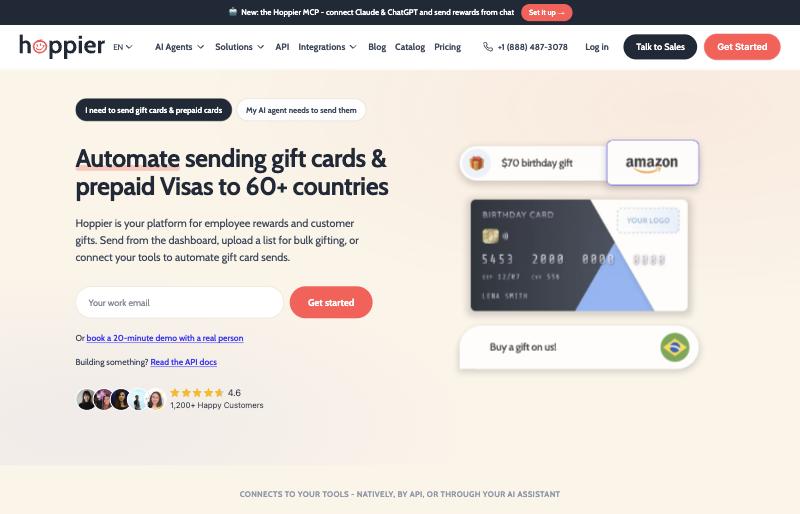
What is Hoppier?
Hoppier is a platform for controlled digital sends: you create a program with a budget, an allowed vendor list, and a spend window; recipients get one email and choose where to spend, from 3,000+ gift card brands or a prepaid Visa, in their own country and currency. Sends can fire from an HRIS roster, from Salesforce (beta), from the gift card API (beta), or from an AI assistant on the Hoppier MCP.
Why Hoppier stands out
- Unspent and unclaimed value returns to your balance on paid plans - across 2,090 programs on our platform, 37% of sent value goes unspent, so this is usually the whole economic argument.
- Starts free with no subscription: you fund face value and send.
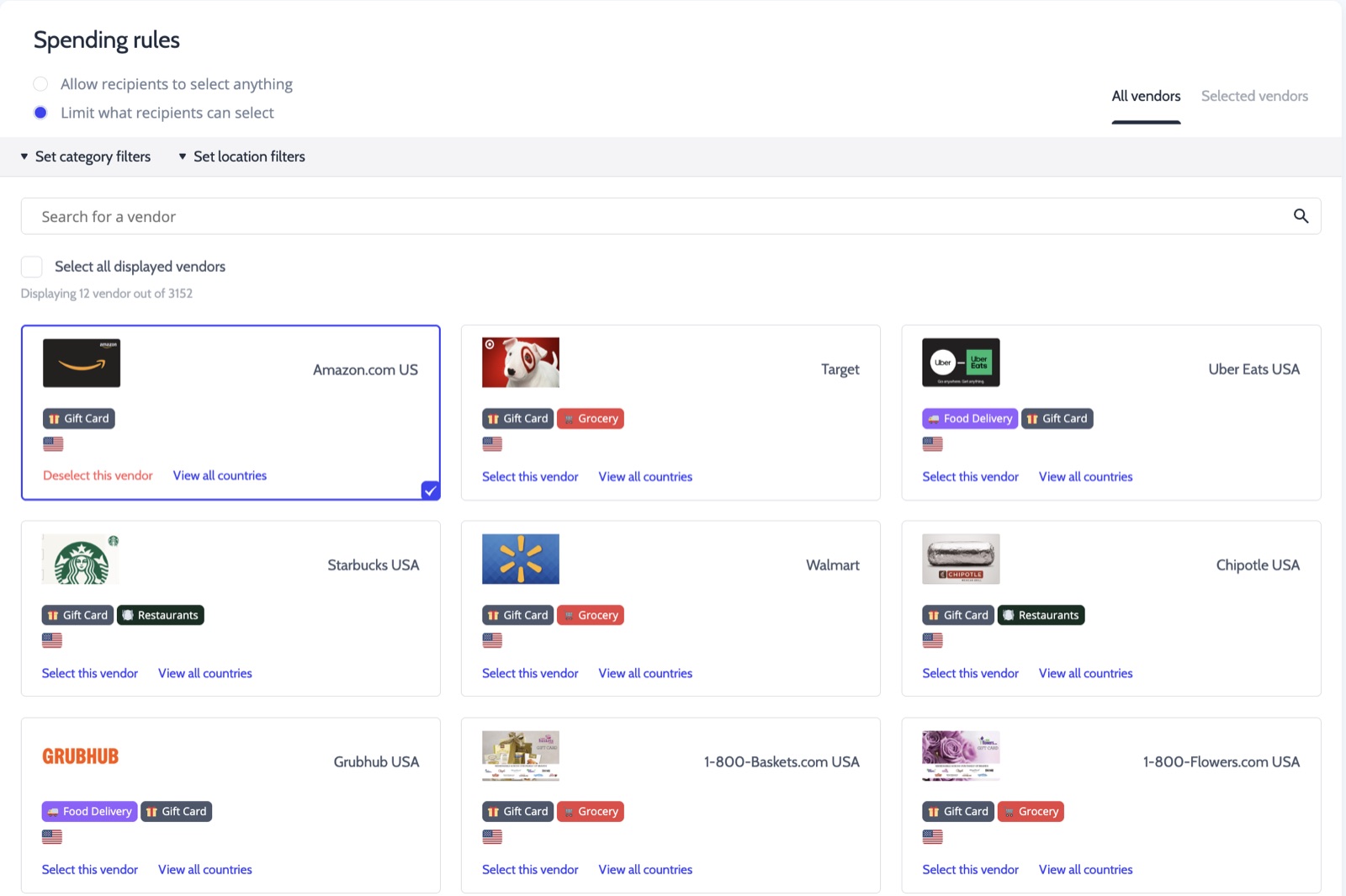
- Recipients choose the brand; you keep the guardrails. Budgets, vendor lists, and spend windows are enforced on our servers.
- The automation surface is current: API in beta, MCP live for Claude and ChatGPT, and if your integration is missing we build a custom one with you.
Hoppier pricing
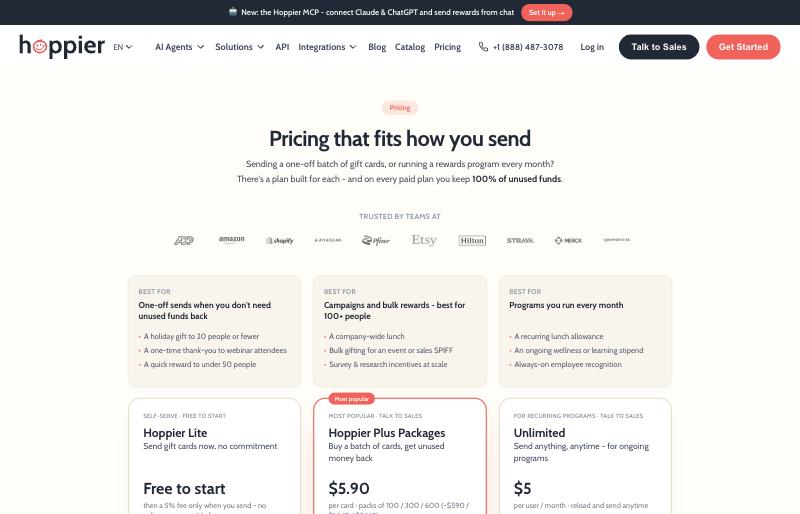
Lite free + 5% per send · Plus $5.90/card in packs · Unlimited $5/user/mo
Lite is self-serve and free to start: fund face value, pay 5% when you send, no unused-funds recovery. Plus is packs of 100, 300, or 600 cards at $5.90 per card with 100% of unused funds back. Unlimited is $5 per user per month for always-on programs like lunch allowances and recognition.
✅ Pros
- 100% of unspent value back on paid plans
- Free to start, no subscription
- 3,000+ brands and prepaid Visa across 60+ countries
- Sends fire from your HRIS, Salesforce, the API, or an AI assistant
- Spend controls enforced server-side, not in a prompt
❌ Cons
- No physical gifting at all - swag boxes and direct mail are not part of the product
- Native integration list is still growing (custom integrations are built with you)
WHO IS HOPPIER BEST FOR?
Teams whose Sendoso usage is mostly digital: meeting incentives, event rewards, customer thank-yous, and internal recognition. If that is you, the unredeemed-value mechanic alone usually pays for the switch.
2. Reachdesk - best like-for-like Sendoso replacement
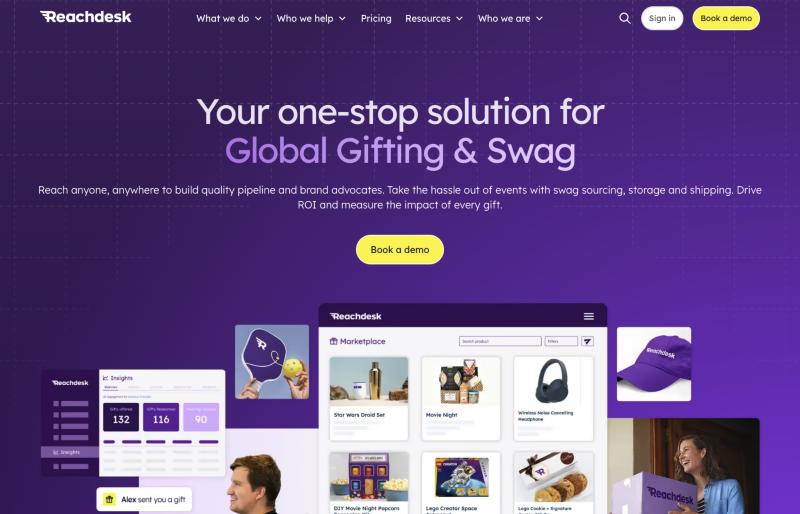
What is Reachdesk?
Reachdesk is the biggest and most similar competitor to Sendoso still independent of it: full-stack gifting, direct mail, and swag with its own global warehouse network, aimed at revenue teams that trigger sends from the CRM.
Why Reachdesk stands out
- The closest feature-for-feature match to Sendoso: physical gifts, swag sourcing and storage, direct mail, and digital sends in one platform.
- Global warehouses, so international physical gifting does not become a customs project.
- Deep CRM-triggered workflows for ABM and pipeline plays.
Reachdesk pricing
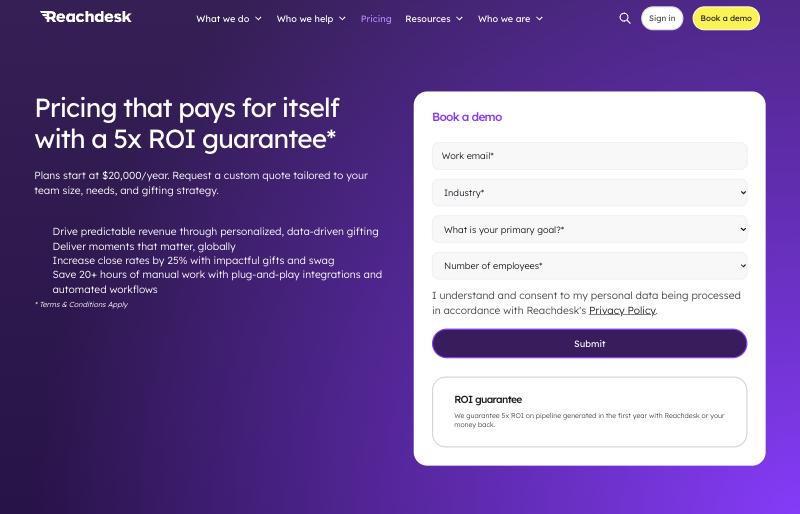
Custom quote - their pricing page says plans start at $20,000/year
Pricing is a sales conversation tailored to team size and gifting strategy, backed by a 5x first-year ROI guarantee. Budget for an enterprise-level commitment.
✅ Pros
- Like-for-like physical gifting replacement for Sendoso
- Independent - not part of the Sendoso roll-up
- Global warehouse logistics under one roof
❌ Cons
- Entry pricing starts around $20K/year
- Digital gift cards are a sidecar to a physical-first product
- Ask the unredeemed-value question before signing
WHO IS REACHDESK BEST FOR?
Physical-first revenue teams that want out of Sendoso specifically, without giving up warehouses, swag storage, or CRM-triggered direct mail.
3. Stadium - best for everything under one roof
What is Stadium?
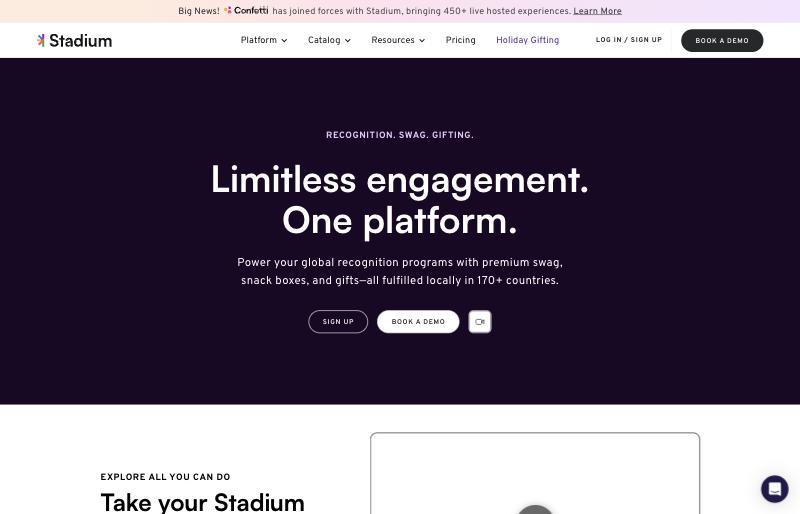
Stadium is the generalist of the group: recognition programs, premium swag, snack boxes, gifts, and group orders in one platform, fulfilled locally in 170+ countries. SnackMagic and SwagMagic are theirs.
Why Stadium stands out
- The widest range on this list - if a team somewhere wants to send it, Stadium probably ships it.
- Pay-as-you-go entry: order what you need without a pass or subscription.
- Higher tiers add branded shops, swag storage, and automated gifting with HRIS, ATS, and CRM integrations.
Stadium pricing
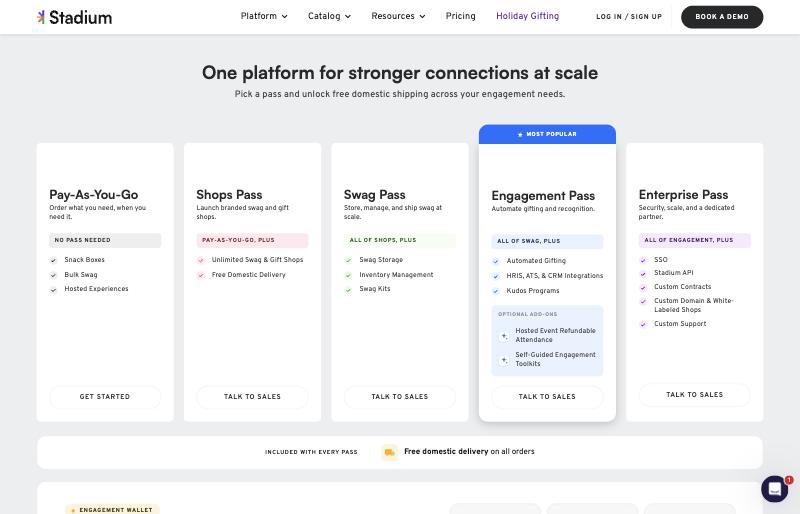
Pay-as-you-go to start · passes unlock shops, swag storage, and automation · pass pricing via sales
You can start ordering with no pass at all. The Shops, Swag, Engagement, and Enterprise passes layer on branded stores, inventory management, automated gifting, and SSO - each one is a talk-to-sales conversation.
✅ Pros
- Swag, snacks, gifts, and recognition from a single vendor
- Start without a subscription
- Local fulfillment in 170+ countries
❌ Cons
- A generalist - each category runs shallower than a specialist tool
- Gift card spend controls and unspent-value recovery are not the center of the product
- Pass pricing requires a sales call
WHO IS STADIUM BEST FOR?
Teams consolidating swag, snack boxes, and recognition onto one vendor - the "everything and anything" program.
4. Snappy - best for internal employee gifting
What is Snappy?
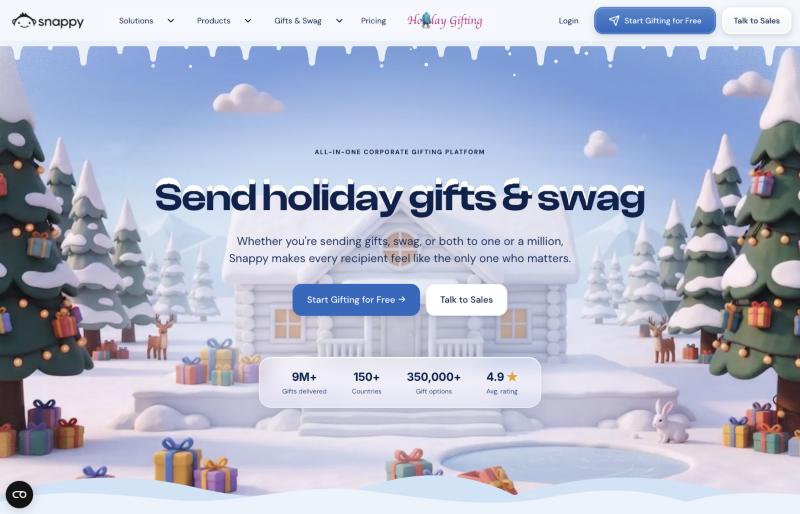
Snappy is recipient-picks-a-gift flows aimed mostly at employee moments: birthdays, anniversaries, holidays, appreciation days. The recipient opens a playful reveal and chooses a gift from a curated collection you budgeted.
Why Snappy stands out
- One of the most polished recipient experiences in gifting - the reveal moment is the product.
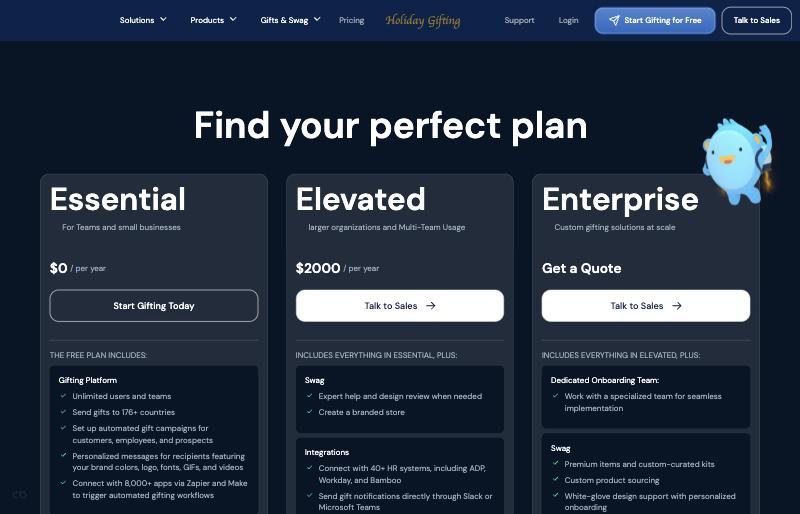
- A genuinely free Essential plan with automated gift campaigns and sends to 176+ countries.
- HR system integrations and Zapier/Make support on paid tiers for birthday and anniversary automation.
Snappy pricing
Essential $0/year · Elevated $2,000/year · Enterprise custom
Essential is free with unlimited users, automated campaigns, and personalized branding - you pay for the gifts. Elevated at $2,000/year adds swag support, a branded store, and 40+ HR integrations. Enterprise brings dedicated onboarding and custom sourcing.
✅ Pros
- Delightful choose-your-own-gift experience recipients remember
- Free plan is real, not a trial
- Automated birthday and anniversary campaigns
❌ Cons
- Built for internal moments more than sales and marketing sends
- Physical gifts mean shipping lead times
- Ask what happens to unclaimed gift budgets
WHO IS SNAPPY BEST FOR?
HR and people teams gifting internally at scale. Less of a fit when the send needs to fire from a CRM stage change.
5. SwagUp - best for managed merch programs
What is SwagUp?
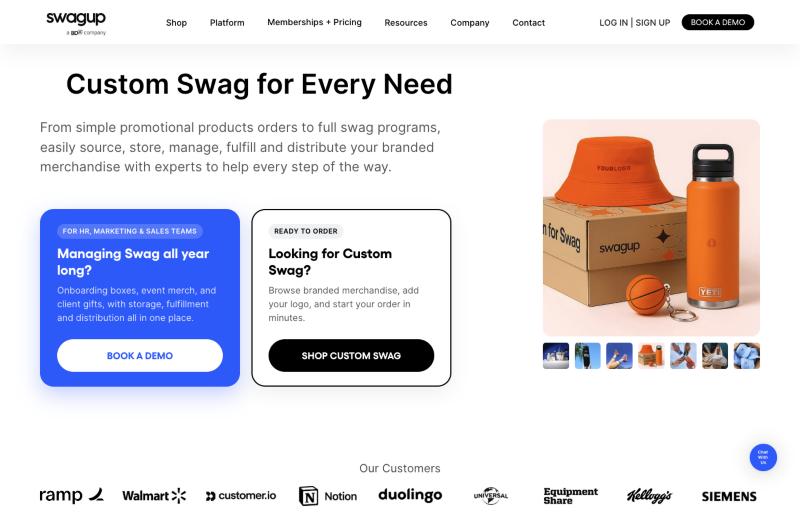
Merch, run as a service: SwagUp sources branded swag, stores it, and ships it - onboarding boxes, event merch, client gifts - with a dashboard and API to trigger distributions.
Why SwagUp stands out
- End-to-end managed: design help, production, warehousing, and fulfillment in one relationship.
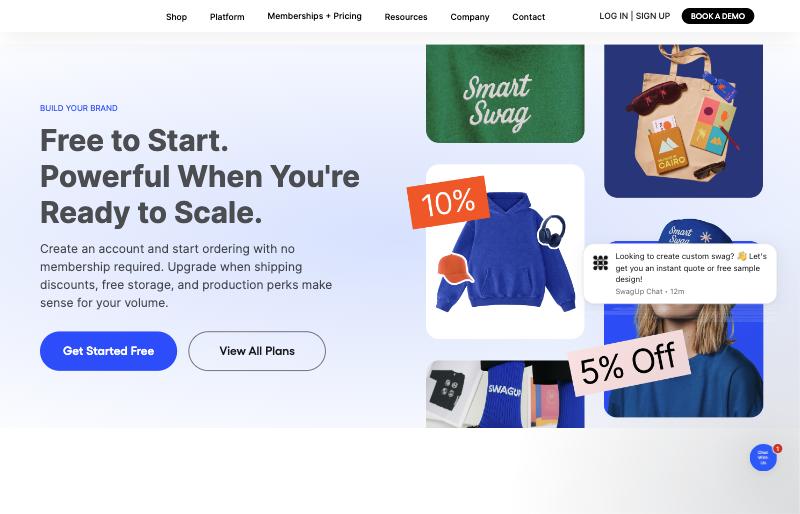
- Free to start with no membership - pay per order.
- Memberships add shipping discounts, free storage, and production perks as volume grows.
SwagUp pricing
Free to start, pay per order · memberships for volume perks
Create an account and order with no membership required. Upgrade when shipping discounts, free storage, and production perks make sense for your volume.
✅ Pros
- Full-service swag program without running your own logistics
- No subscription to start
- Storage and distribution handled for you
❌ Cons
- Merch only - no gift cards, incentives, or digital sends
- Per-order economics need watching as volume grows
WHO IS SWAGUP BEST FOR?
HR and marketing teams managing swag all year long - onboarding kits, events, and client gifts as a managed program.
6. Swag.com - best for self-serve bulk merch
What is Swag.com?
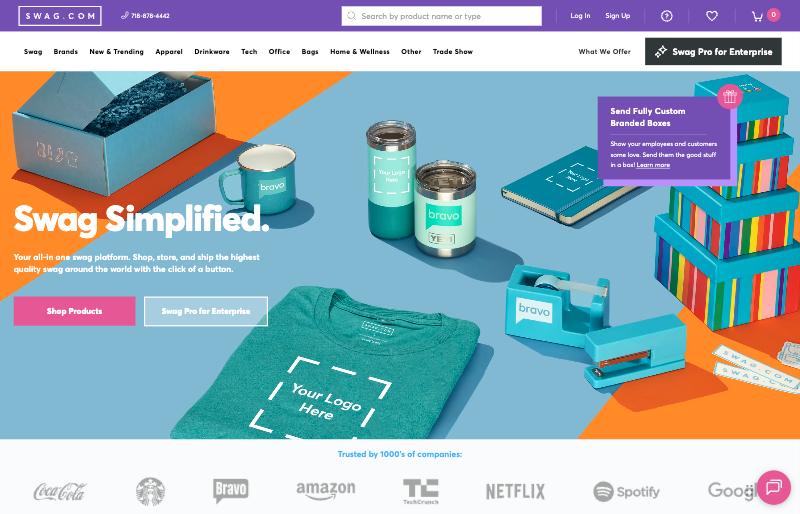
Also merch only, but self-serve: pick products, add your logo, order in bulk, and optionally store and ship from their dashboard. Think e-commerce store rather than managed program.
Why Swag.com stands out
- Fast, self-serve flow from product pick to bulk order.
- Per-product pricing shown on every item - no quote cycle.
- Optional storage and distribution once you have inventory.
Swag.com pricing
Per-product pricing, shown on each item
There is no platform fee or subscription to browse and order; each product carries its own bulk price breaks. Storage and shipping services price per use.
✅ Pros
- Transparent per-product pricing
- No subscription or sales call to get started
- Decent quality bar for standard swag items
❌ Cons
- Merch only - not a gifting workflow or incentives platform
- DIY: you run the program, they print and ship
WHO IS SWAG.COM BEST FOR?
One-off or recurring bulk merch orders where you want to see prices and order today, without a service relationship.
Quick Comparison Table
| Tool | Pricing model | Physical gifting | Gift cards & payouts | Unspent value back | Best for |
|---|---|---|---|---|---|
| Hoppier | Free to start, fund face value | ❌ No | ✅ Core | ✅ 100% on Plus | Gift-card-first teams |
| Sendoso | Subscription | ✅ Core | ✅ Yes | ❌ Typically spent | Physical + enterprise |
| Reachdesk | Subscription | ✅ Core | ✅ Yes | ⚠️ Ask | Like-for-like switch |
| Stadium | Free to start + tiers | ✅ Core | ⚠️ Some | ⚠️ Ask | One vendor for all of it |
| Snappy | Free to start + tiers | ✅ Core | ⚠️ Some | ⚠️ Ask | Employee gifting |
| SwagUp | Per order + memberships | ✅ Merch only | ❌ No | n/a | Managed merch |
| Swag.com | Per order | ✅ Merch only | ❌ No | n/a | Self-serve bulk merch |
Whichever you shortlist, ask every vendor the same first question: what happens to the value my recipients never claim? The answers vary more than any feature list, and that line item usually decides the real cost. The ⚠️ cells above are exactly where to ask it.
Gift-card-first shoppers comparing catalogs and APIs can also see our Tango Card comparison and the gift card API ranking.
The Sendoso Flow
Credit where due: Sendoso's sending workflow is polished, and its Salesforce integration is deep. Here is their own walkthrough of an automated send when a meeting is booked:
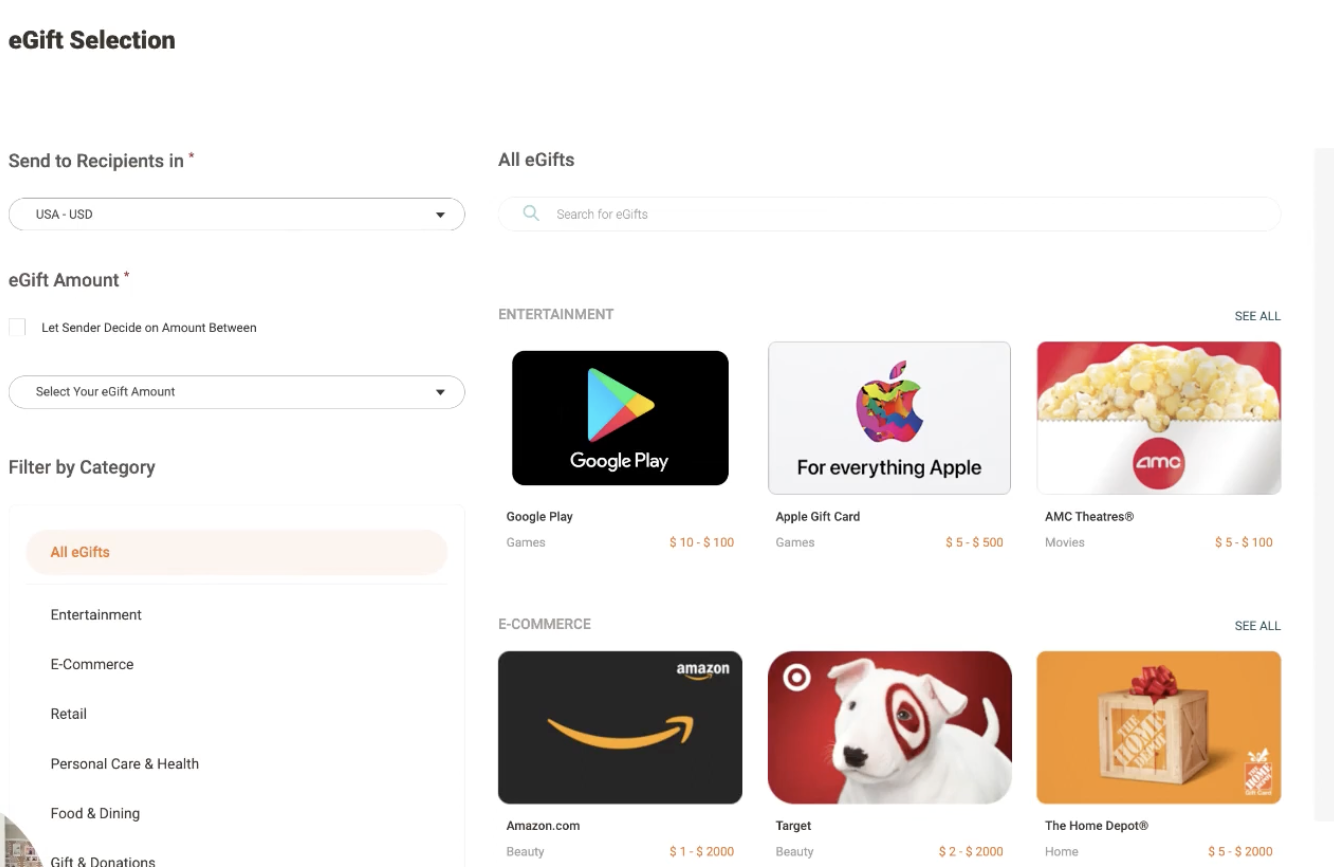
The sender picks a specific brand eGift from a catalog, each with its own amount range:
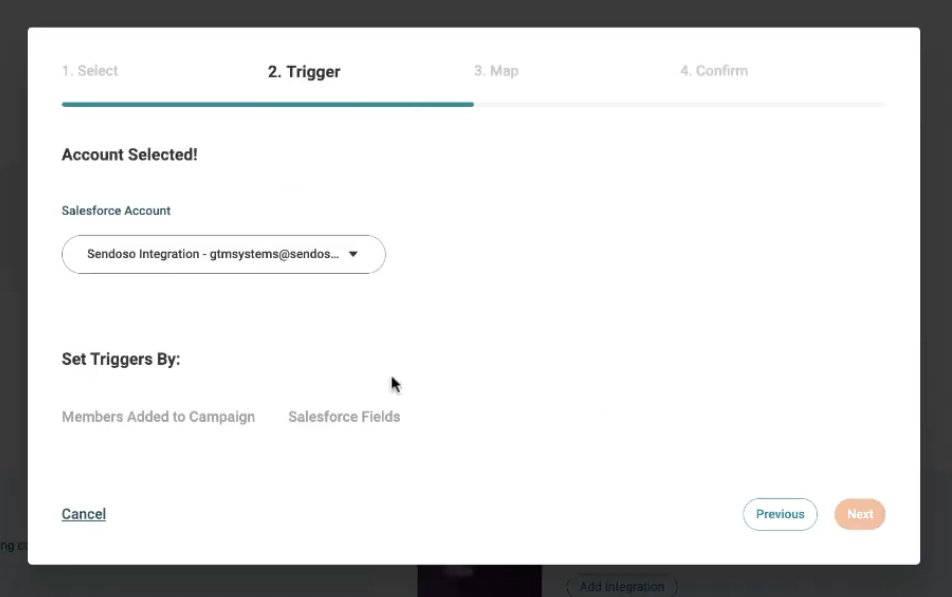
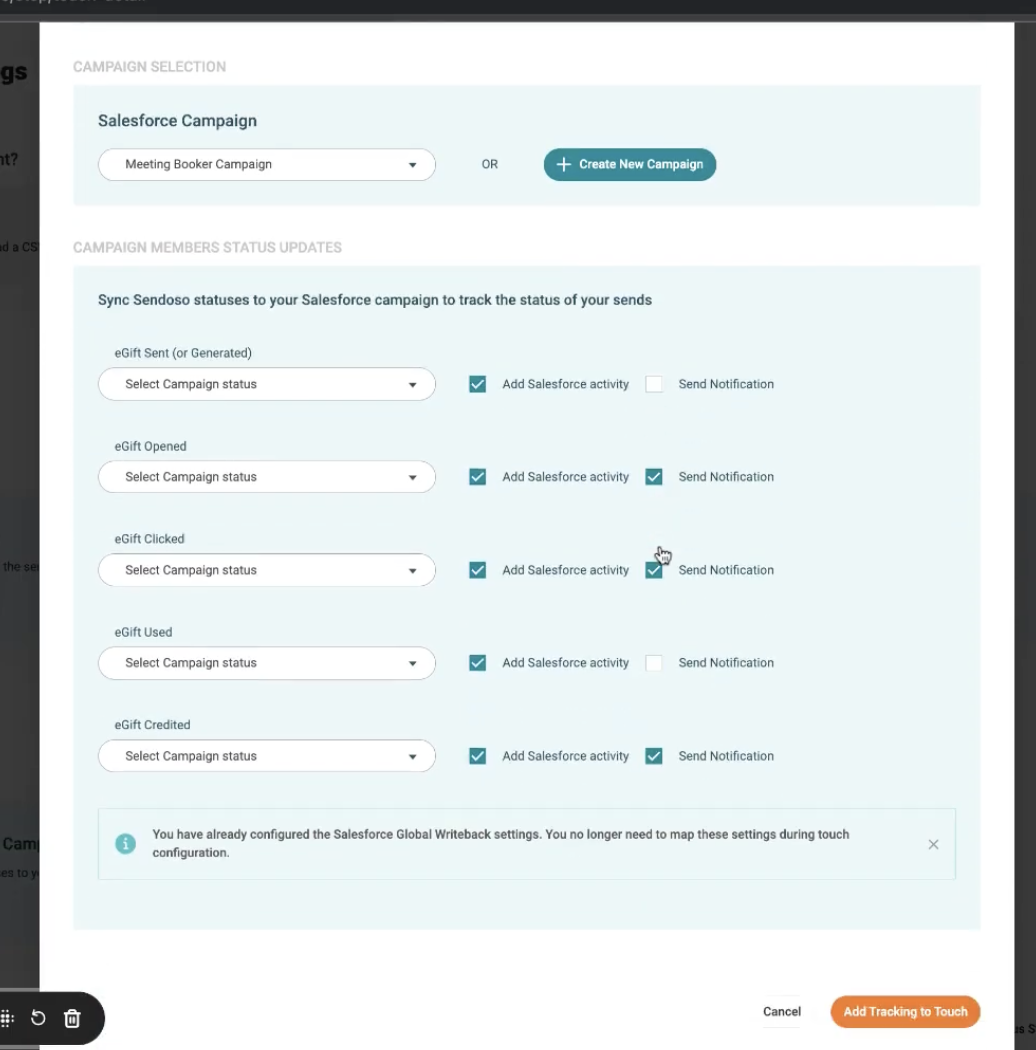
Triggers come from Salesforce campaigns or field changes, and send statuses write back to the campaign - genuinely useful if your marketing ops lives in Salesforce:
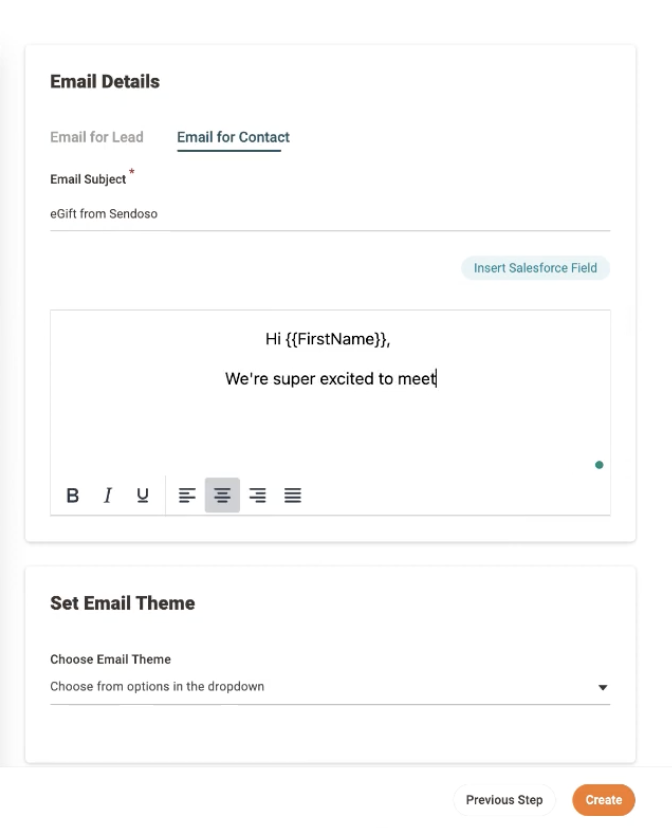
Email templates are configured per touch, with merge fields:
The structural thing to notice: the sender picks the brand. If you choose Starbucks and the recipient doesn't drink coffee, that value is at risk of becoming part of the unredeemed third.
The Hoppier Flow, Side by Side
Here is the equivalent walkthrough on Hoppier - creating a program, sending, and what the recipient sees:
Creation can happen in the dashboard - or you can skip the dashboard entirely and ask an AI assistant. This is a real program being created through the Hoppier MCP: one message with the budget, timing, and merchant rules, and Claude sets it up:
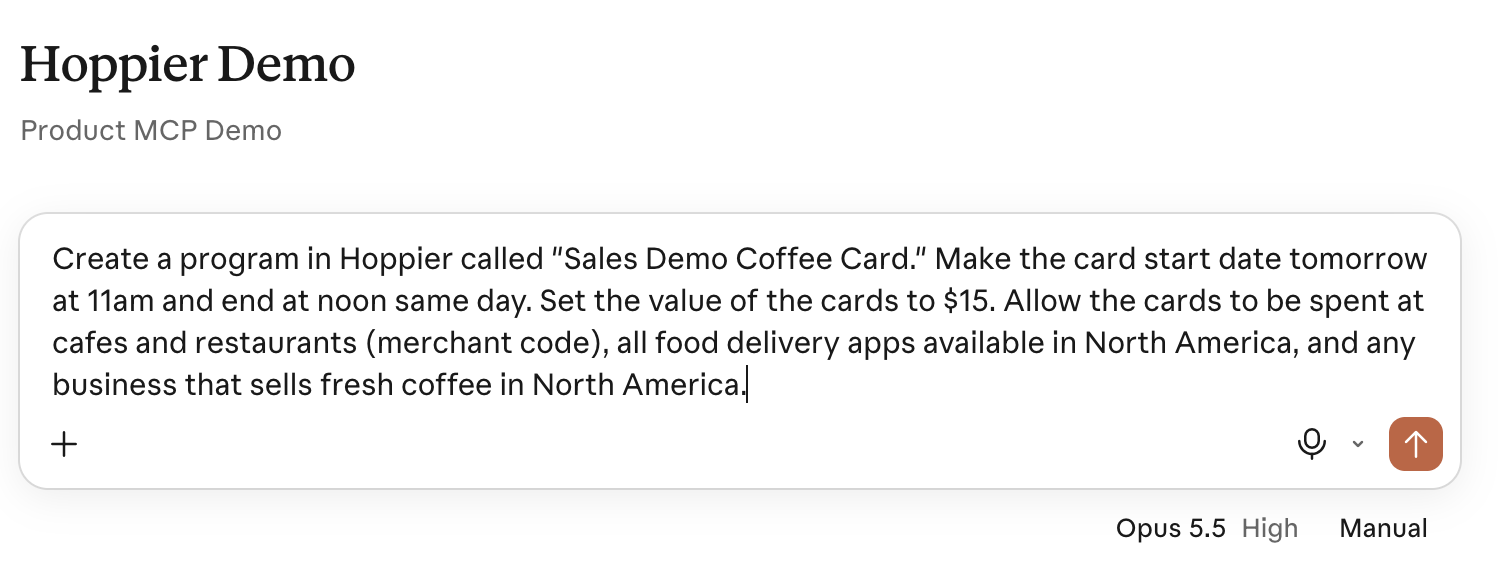
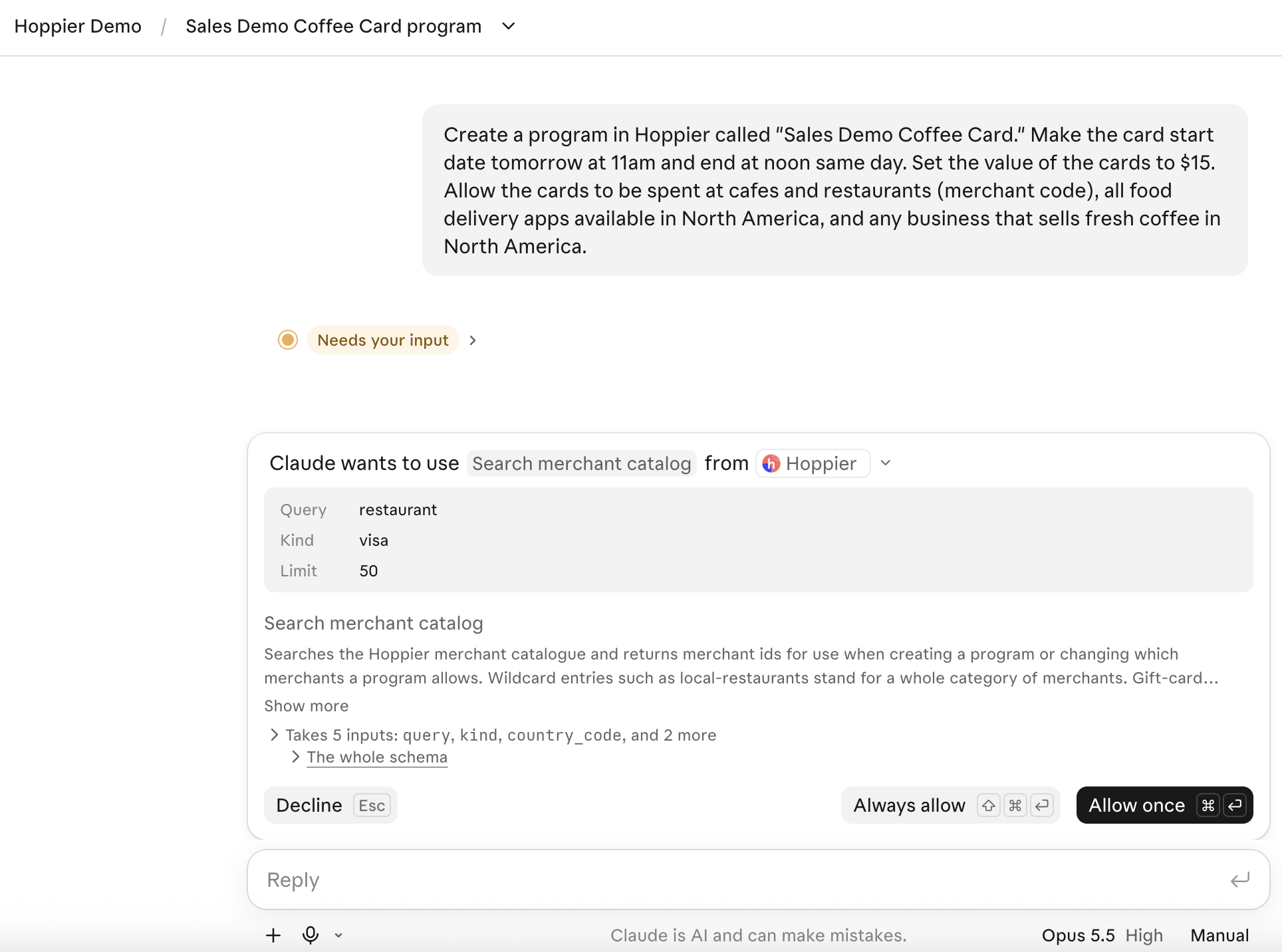
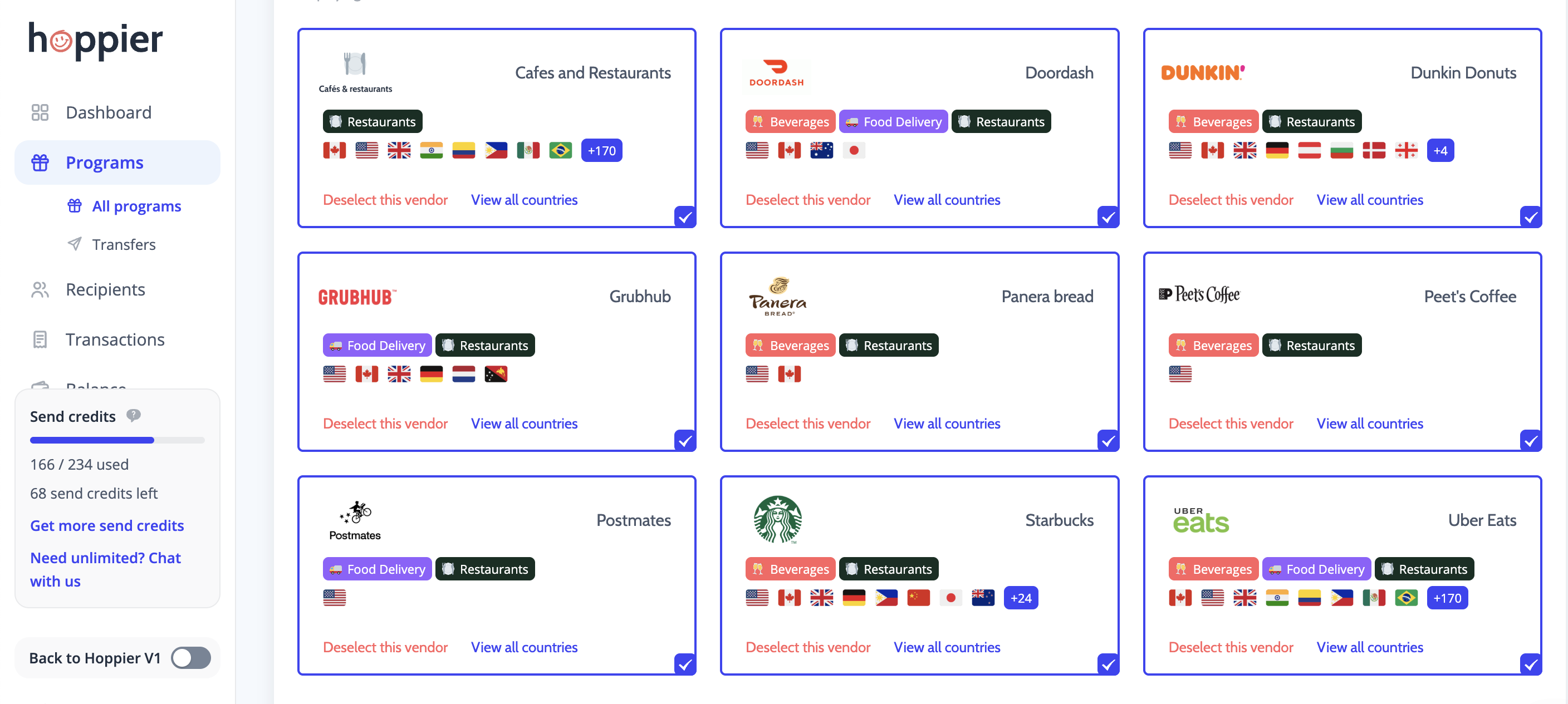
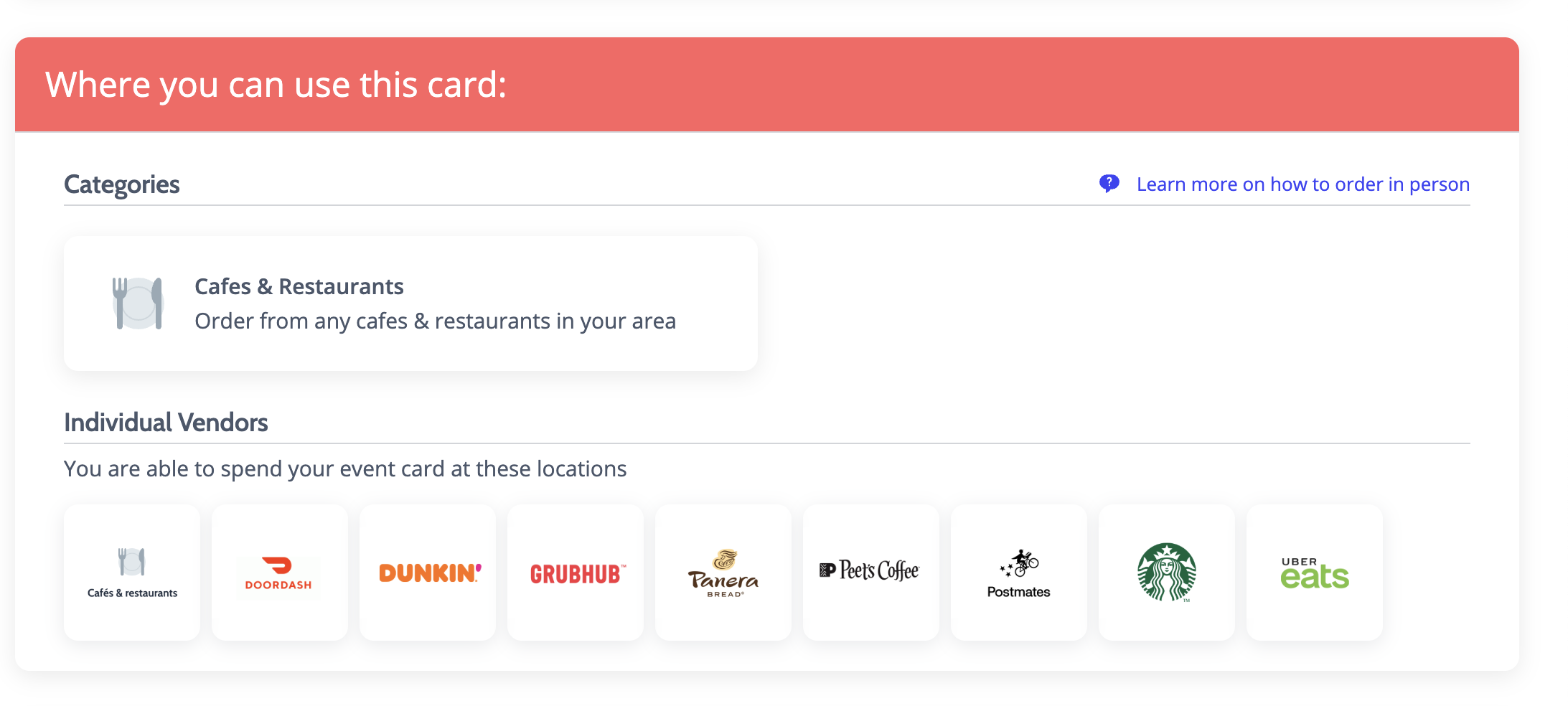
Instead of picking one brand, you set the boundaries - categories like cafes and restaurants, specific vendors, countries - and the recipient chooses within them:
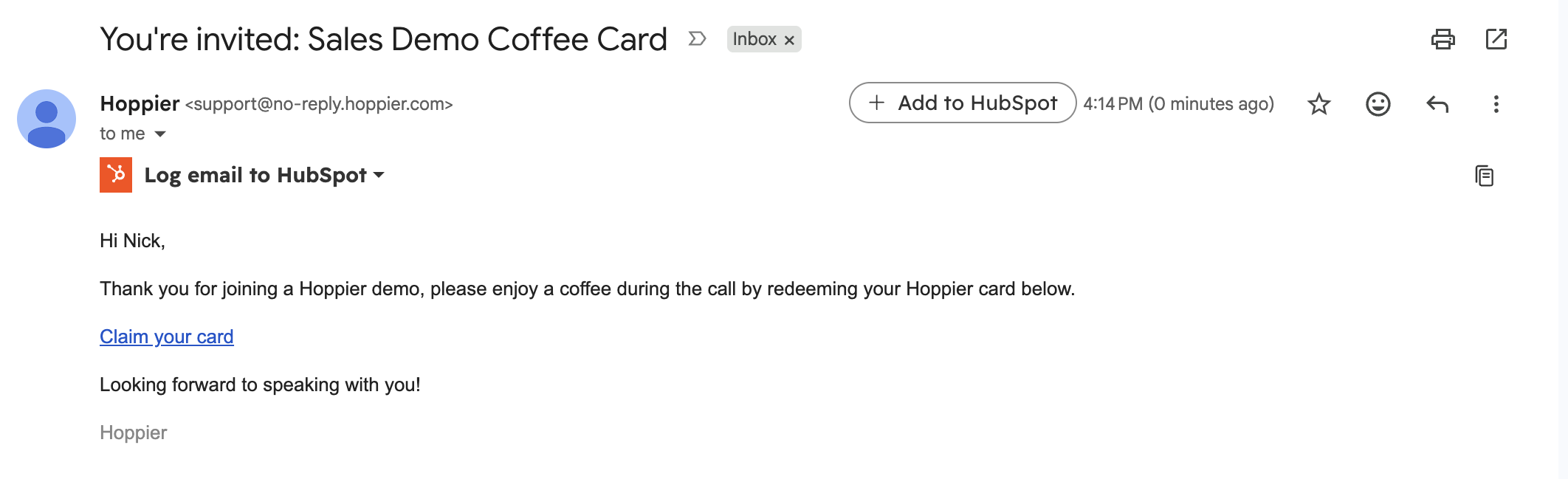
Recipients get one email and claim a card they can spend at any allowed vendor - no account creation gymnastics, and in 60+ countries they see options in their own currency:
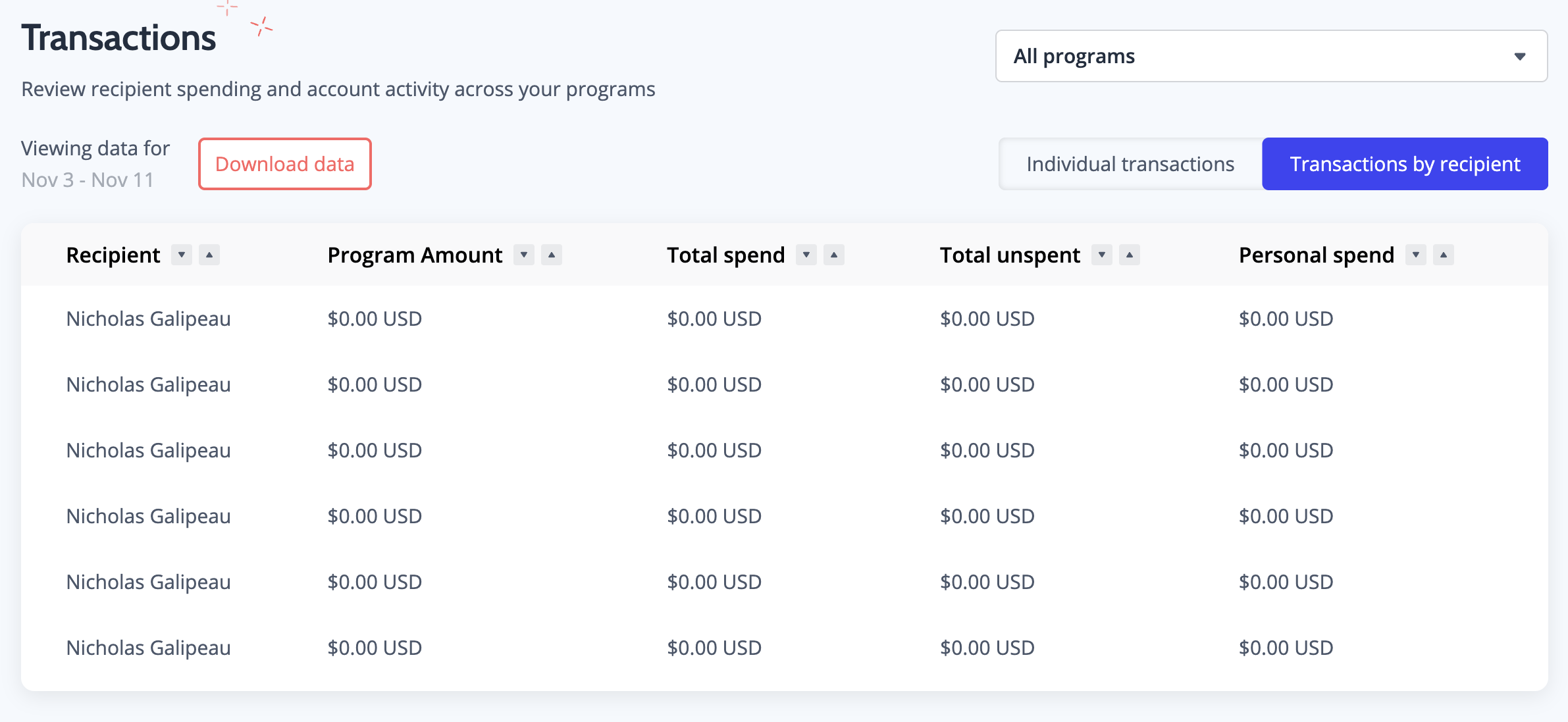
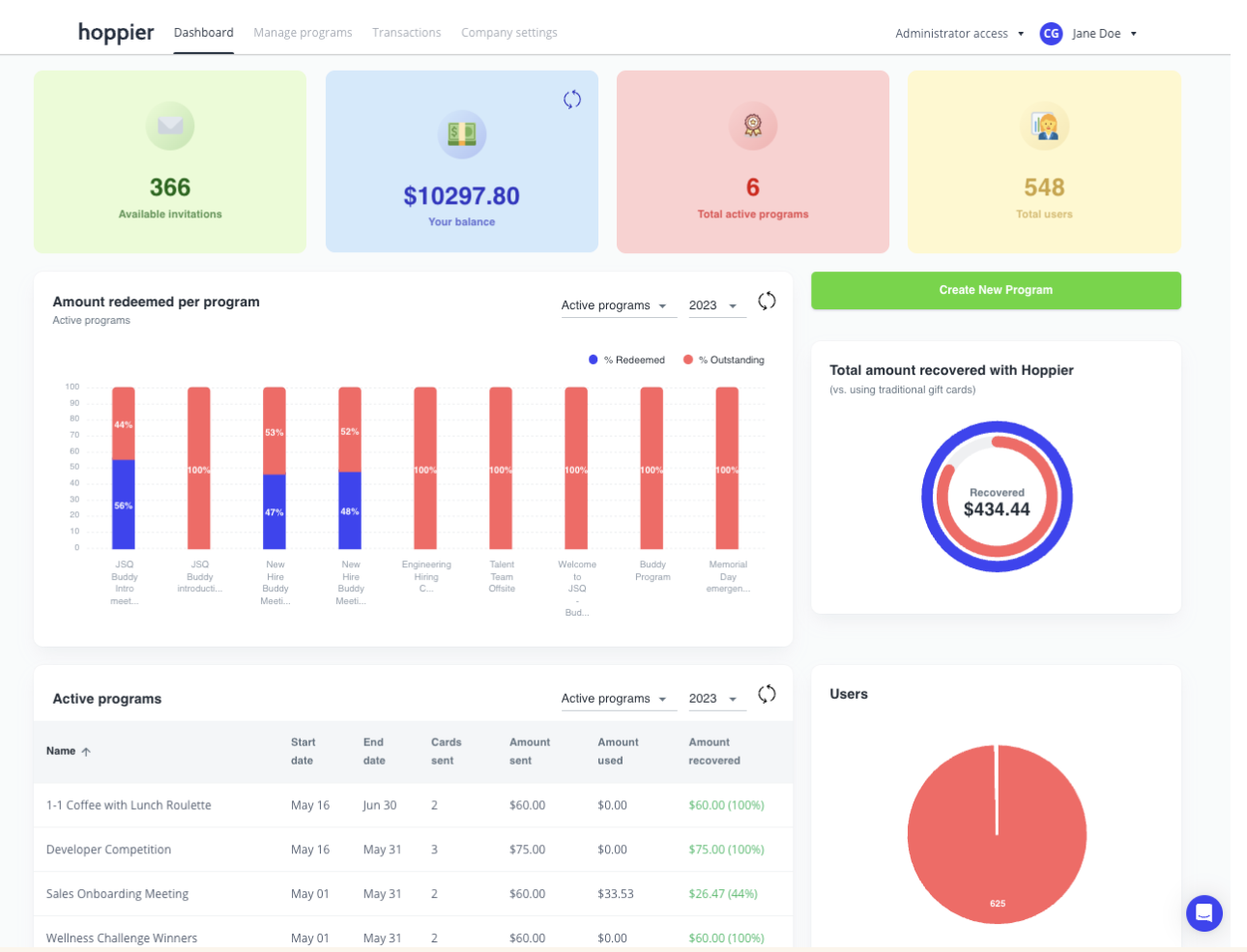
And admins watch spend, claims, and - the important column - unspent value, which returns to your balance on Plus plans instead of disappearing:
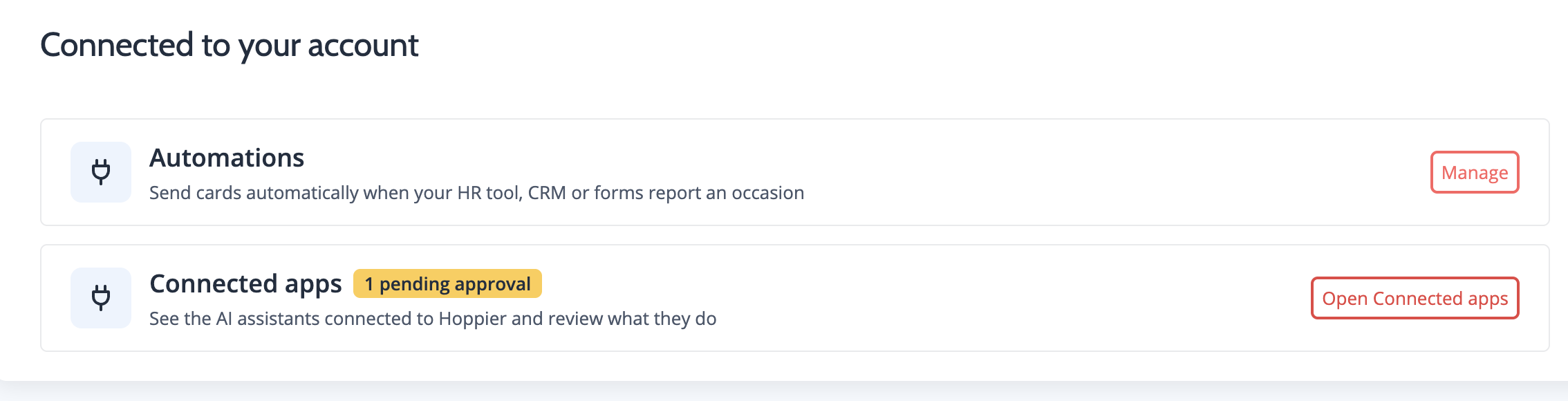
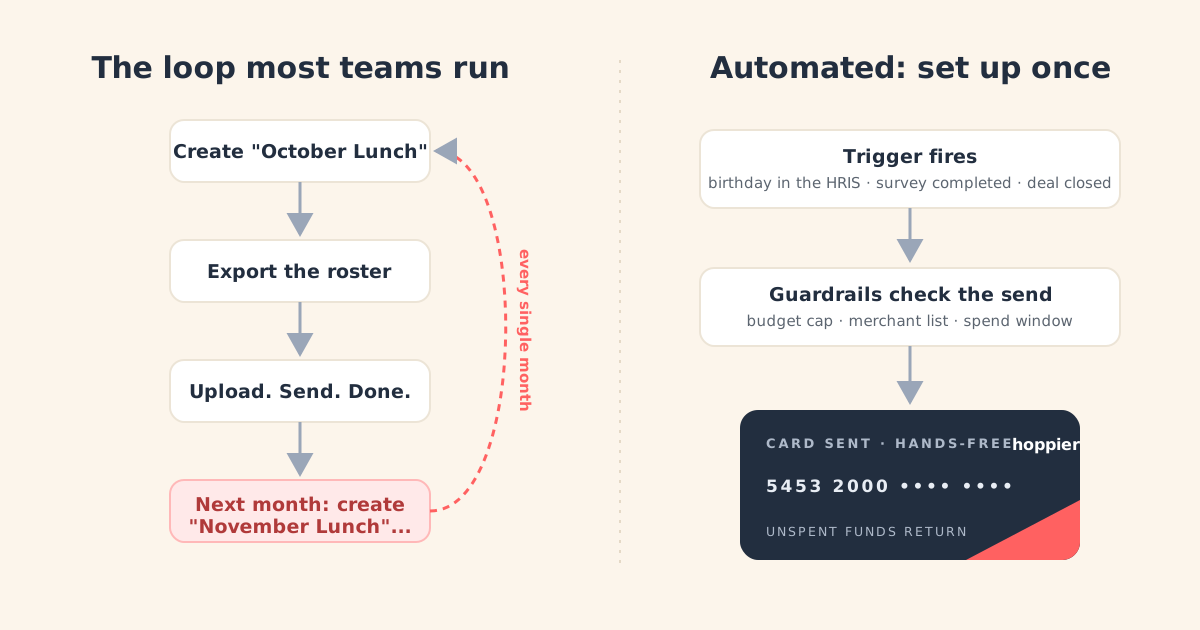
Event-triggered sends run through integrations - the Salesforce integration (beta) covers the deal-closed and meeting-booked use cases - or through automations that fire when your HR tool, CRM, or a form reports an occasion:
The Money Difference, In One Example
Send 100 people $50. At typical redemption rates, roughly a third of that value - about $1,650 - goes unclaimed or unspent. On a platform where unredeemed value is simply spent money, your effective cost per redeemed dollar is about 50% higher than it looks. On Hoppier Plus, that unspent value returns to your balance, so you fund what people actually use. The mechanics are covered in our gift card breakage guide, and pricing is public: free to start with no subscription, Plus packages at $5.90 per card with 100% recovery.
What Makes Hoppier Different
The differences cut both ways. Here is what Sendoso keeps over us, so you can weigh it against the economics above:
- Physical gifting. Sendoso packages and mails things; Hoppier does not. Teams that need both often run both - Sendoso for the quarterly swag box, Hoppier for everything digital - and Hoppier's no-subscription entry makes the split cheap to run.
- A longer-tenured support and services organization. Customers consistently praise Sendoso's support, and they have earned that reputation.
- Procurement paperwork. If your security review requires specific compliance certifications on a deadline, confirm current certification status with both vendors directly before committing - it changes, and no blog post stays accurate on it for long.
One more honest data point: a customer who split-tested both platforms a few years ago saw better attendance rates on the Sendoso side - at a time when Hoppier lacked the native integrations it has now, and at meaningfully higher cost. The integration gap that drove that result has since closed, which is exactly why "run your own test" is the only advice in this post we are fully confident generalizes.
FAQ
What is the best Sendoso alternative for physical gifting?
Reachdesk, in most cases - it is the main full-stack gifting and direct mail platform Sendoso has not acquired. Postal and Alyce both now belong to Sendoso, so read older lists that recommend them with that in mind.
Is Hoppier cheaper than Sendoso?
At entry, clearly: free to start, no subscription, and you fund face value. At enterprise scale the comparison depends on your redemption rates - which is why the unredeemed-value recovery usually matters more than the sticker price. Model it with your own send volume before deciding.
Can I keep my Salesforce and HR integrations if I switch?
The Salesforce integration (beta) covers triggered sends from leads, contacts, and opportunities, and the integrations directory lists what each HRIS and survey tool supports today. For custom workflows there is the gift card API (beta) and the Hoppier MCP for AI assistants.
What happens to cards nobody claims?
On Hoppier Plus plans, 100% of unclaimed and unspent value returns to your balance after the expiry window you set. That single mechanic is the most common reason teams switch.
Do recipients have to pick one brand?
No - that is the model difference. You set the budget and the allowed vendors or categories; each recipient chooses where to spend, from 3,000+ gift card brands or a prepaid Visa (on paid plans), in their own country and currency.

Make Hoppier your unfair advantage
Send rewards, gifts, and perks to employees, clients, and event attendees in 60+ countries - all from one platform.
Get Started